楮 (chǔ) means "paper mulberry" in Chinese. It has 12 strokes with the radical 木.
Rated 4.2/5 in difficulty (advanced).
Appears in 3+ common words including 楮纸 (chǔ zhǐ), 楮币 (chǔ bì), 楮木 (chǔ mù).
Due to its 12 strokes, Hanzi Writer's error detection shows 楮 requires focused practice — most learners need 10+ attempts for consistent accuracy.
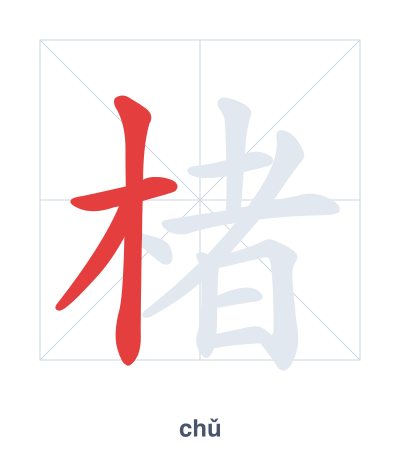
Open Hanzi Writer to see the animated stroke order and practice writing 楮 with real-time feedback.
The character 楮 (chǔ) is written with 12 strokes. Follow the standard Chinese stroke order: top to bottom, left to right, outside before inside. The radical 木 is one of its key components.
Practice the correct stroke order with the Hanzi Writer app to see animated stroke-by-stroke guidance with real-time feedback.
楮 means paper mulberry.
楮 is a phono-semantic compound combining the tree radical 木 with 者 (chǔ) as a phonetic hint. The paper mulberry tree's inner bark was prized for making high-quality paper in ancient China.
💡 Memory Tip: Imagine a papermaker (者) standing next to a tree (木) stripping its bark to make sheets of paper.
这种楮纸很薄。
zhè zhǒng chǔ zhǐ hěn báo
This paper mulberry paper is very thin.
古代有人使用楮币。
gǔ dài yǒu rén shǐ yòng chǔ bì
Some people used paper money in ancient times.
楮木可以用来造纸。
chǔ mù kě yǐ yòng lái zào zhǐ
Paper mulberry wood can be used to make paper.
Open Hanzi Writer to see the animated stroke order and practice writing 楮 with real-time feedback.
✨ Animated stroke order · Handwriting recognition · HSK-graded practice · Free to use
楮 is composed of the radical 木 (wood/tree) on the left, indicating it is a type of tree. The right side is 者 (zhě), which originally provided pronunciation but also hints at the tree's use in making paper (paper is made from fibrous material). Together, the character literally means 'paper mulberry tree.'