铳 (chòng) means "Punch (tool); blunderbuss" in Chinese. It has 11 strokes with the radical 钅.
Rated 4.2/5 in difficulty (advanced).
Appears in 3+ common words including 火铳 (huǒ chòng), 铳子 (chòng zi), 铳床 (chòng chuáng).
Due to its 11 strokes, Hanzi Writer's error detection shows 铳 requires focused practice — most learners need 10+ attempts for consistent accuracy.
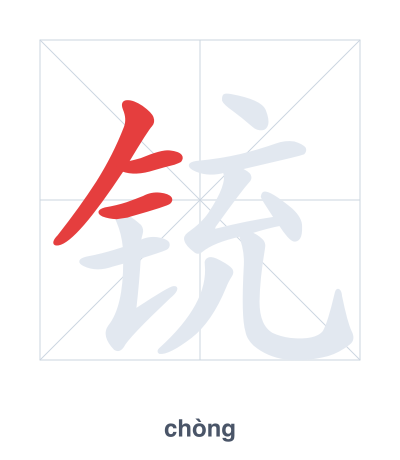
Open Hanzi Writer to see the animated stroke order and practice writing 铳 with real-time feedback.
The character 铳 (chòng) is written with 11 strokes. Follow the standard Chinese stroke order: top to bottom, left to right, outside before inside. The radical 钅 is one of its key components.
Practice the correct stroke order with the Hanzi Writer app to see animated stroke-by-stroke guidance with real-time feedback.
铳 means Punch (tool); blunderbuss.
铳 combines the metal radical 钅 (jīn) with 充 (chōng, 'to fill'), suggesting a metal tube filled with gunpowder to fire projectiles. Originally a hand-held firearm like a blunderbuss, it later also referred to a metal punching tool.
💡 Memory Tip: Imagine a metal pipe (钅) stuffed full (充) of gunpowder—when lit, it punches a hole in the target.
这是古代的火铳。
zhè shì gǔ dài de huǒ chòng
This is an ancient hand cannon.
他用铳子打孔。
tā yòng chòng zi dǎ kǒng
He used a punch to make a hole.
工厂里有铳床。
gōng chǎng lǐ yǒu chòng chuáng
There is a punching machine in the factory.
Open Hanzi Writer to see the animated stroke order and practice writing 铳 with real-time feedback.
✨ Animated stroke order · Handwriting recognition · HSK-graded practice · Free to use
The character 铳 combines the metal radical 钅 (jīn) on the left with 充 (chōng, meaning "fill" or "full") on the right. The metal radical suggests the object is made of metal, while 充 hints at a tool that "fills" or fires projectiles, like a blunderbuss or a punch tool.