潺 (chán) means "gurgling sound of water" in Chinese. It has 15 strokes with the radical 氵.
Rated 4.2/5 in difficulty (advanced).
Appears in 3+ common words including 潺潺 (chán chán), 溪水潺潺 (xī shuǐ chán chán), 流水潺潺 (liú shuǐ chán chán).
Due to its 15 strokes, Hanzi Writer's error detection shows 潺 requires focused practice — most learners need 10+ attempts for consistent accuracy.
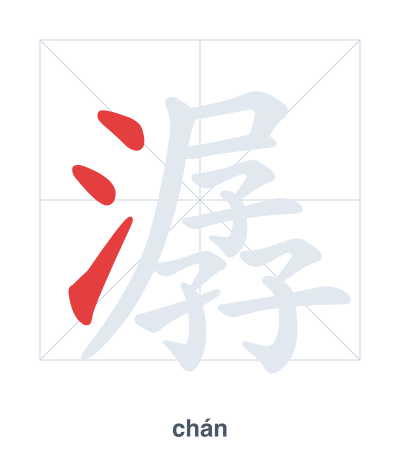
Open Hanzi Writer to see the animated stroke order and practice writing 潺 with real-time feedback.
The character 潺 (chán) is written with 15 strokes. Follow the standard Chinese stroke order: top to bottom, left to right, outside before inside. The radical 氵 is one of its key components.
Practice the correct stroke order with the Hanzi Writer app to see animated stroke-by-stroke guidance with real-time feedback.
潺 means gurgling sound of water.
This character is a phono-semantic compound. The radical 氵 (water) indicates the meaning relates to water, while 孱 (chán, originally meaning 'weak' but used here as a phonetic) provides the sound. Together they depict the gentle, gurgling sound of flowing water.
💡 Memory Tip: Picture three little kids (孨) hiding under a sheet (尸) near a stream (氵), making 'chán chán' gurgling noises.
溪水潺潺地流着。
xī shuǐ chán chán dì liú zhe
The stream is flowing with a babbling sound.
远处溪水潺潺。
yuǎn chù xī shuǐ chán chán
The stream gurgled in the distance.
山间流水潺潺。
shān jiān liú shuǐ chán chán
The mountain stream gurgles.
Open Hanzi Writer to see the animated stroke order and practice writing 潺 with real-time feedback.
✨ Animated stroke order · Handwriting recognition · HSK-graded practice · Free to use
潺 is composed of the radical 氵 (water) on the left and the phonetic component 孱 on the right. The water radical directly connects to the meaning of flowing water sounds, while 孱 provides the pronunciation chán. Together they create the idea of a gentle, murmuring gurgle made by a stream.