侪 (chái) means "Peers / Companions" in Chinese. It has 8 strokes with the radical 亻.
Rated 3.4/5 in difficulty (challenging).
Appears in 3+ common words including 侪辈 (chái bèi), 吾侪 (wú chái), 侪等 (chái děng).
Due to its 8 strokes, Hanzi Writer's error detection shows 侪 requires focused practice — most learners need 10+ attempts for consistent accuracy.
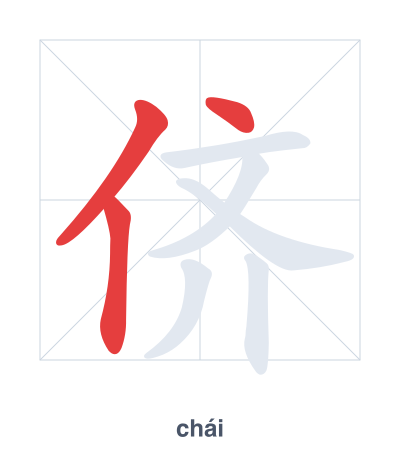
Open Hanzi Writer to see the animated stroke order and practice writing 侪 with real-time feedback.
The character 侪 (chái) is written with 8 strokes. Follow the standard Chinese stroke order: top to bottom, left to right, outside before inside. The radical 亻 is one of its key components.
Practice the correct stroke order with the Hanzi Writer app to see animated stroke-by-stroke guidance with real-time feedback.
侪 means Peers / Companions.
侪 is a compound character combining the radical 亻 (person) with 齐 (alike, equal). The person radical indicates it relates to people, while 齐 conveys the idea of being on the same level, together forming the meaning of 'peers' or 'companions.'
💡 Memory Tip: Picture a person (亻) standing beside a row of equal marks (齐)—they are your peers, all on the same level.
我们是侪辈。
wǒ men shì chái bèi
We are peers.
吾侪应当努力。
wú chái yīng dāng nǔ lì
We should work hard.
侪等皆为兄弟。
chái děng jiē wèi xiōng dì
We are all brothers.
Open Hanzi Writer to see the animated stroke order and practice writing 侪 with real-time feedback.
✨ Animated stroke order · Handwriting recognition · HSK-graded practice · Free to use
侪 is composed of the radical 亻 (person) on the left and 齐 (qí, meaning equal or level) on the right. The person radical indicates people, and 齐 suggests equality or same status, together meaning peers or companions.