涔 (cén) means "overflowing; streaming (of sweat or tears)" in Chinese. It has 10 strokes with the radical 氵.
Rated 4.2/5 in difficulty (advanced).
Appears in 3+ common words including 汗涔涔 (hàn cén cén), 泪涔涔 (lèi cén cén), 涔涔 (cén cén).
Due to its 10 strokes, Hanzi Writer's error detection shows 涔 requires focused practice — most learners need 10+ attempts for consistent accuracy.
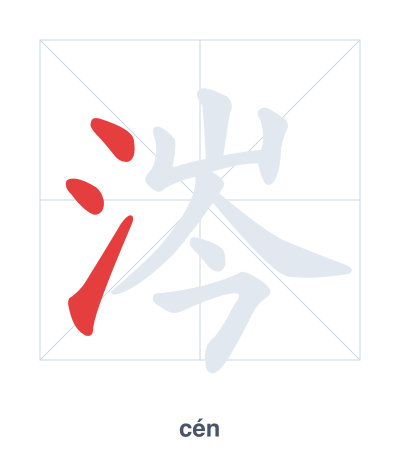
Open Hanzi Writer to see the animated stroke order and practice writing 涔 with real-time feedback.
The character 涔 (cén) is written with 10 strokes. Follow the standard Chinese stroke order: top to bottom, left to right, outside before inside. The radical 氵 is one of its key components.
Practice the correct stroke order with the Hanzi Writer app to see animated stroke-by-stroke guidance with real-time feedback.
涔 means overflowing; streaming (of sweat or tears).
涔 is a phono-semantic compound: the radical 氵 indicates water, and 岑 (cén, 'small hill') supplies sound and also the image of water seeping or streaming down a steep slope. This combination evokes overflowing or continuous flow, like sweat or tears streaming down.
💡 Memory Tip: Imagine a mountain (山) with a person (今) on top, sweating so much that water (氵) streams down the slope like a little waterfall.
他跑得汗涔涔的。
tā pǎo dé hàn cén cén de
He ran until he was all sweaty.
她听得泪涔涔。
tā tīng dé lèi cén cén
She was moved to tears while listening.
雨水涔涔落下。
yǔ shuǐ cén cén là xià
Rainwater is streaming down.
Open Hanzi Writer to see the animated stroke order and practice writing 涔 with real-time feedback.
✨ Animated stroke order · Handwriting recognition · HSK-graded practice · Free to use
涔 is composed of the water radical 氵 on the left and 今 (jīn, meaning 'now') on the right. The water radical suggests the meaning relates to liquid, and 今 adds a phonetic hint for pronunciation 'cén'. Together, they form the idea of water overflowing or streaming, like sweat or tears.