皕 (bì) means "Two hundred" in Chinese. It has 12 strokes with the radical 白.
Rated 3.9/5 in difficulty (challenging).
Appears in 3+ common words including 皕宋 (bì sòng), 皕年 (bì nián), 皕部 (bì bù).
Due to its 12 strokes, Hanzi Writer's error detection shows 皕 requires focused practice — most learners need 10+ attempts for consistent accuracy.
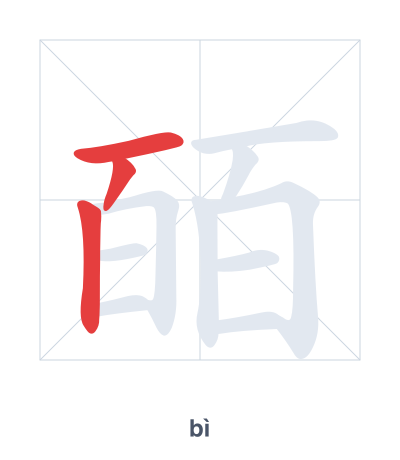
Open Hanzi Writer to see the animated stroke order and practice writing 皕 with real-time feedback.
The character 皕 (bì) is written with 12 strokes. Follow the standard Chinese stroke order: top to bottom, left to right, outside before inside. The radical 白 is one of its key components.
Practice the correct stroke order with the Hanzi Writer app to see animated stroke-by-stroke guidance with real-time feedback.
皕 means Two hundred.
| Character | 皕 |
| Pinyin | bì (bi) |
| Meaning | Two hundred |
| Strokes | 12 |
| Radical | 白 |
| Difficulty | 3.9/5 |
皕 is a compound character formed by duplicating 百 (hundred), where two 百 side by side literally mean 'two hundred.' The character visually repeats the structure of 百, emphasizing the doubling of the quantity.
💡 Memory Tip: Picture two white (白) hundred-dollar bills stacked together, totaling two hundred.
皕宋楼很有名。
bì sòng lóu hěn yǒu míng
Bisong Pavilion is very famous.
皕年就是两百年。
bì nián jiù shì liǎng bǎi nián
"Binian" means two hundred years.
他读了皕部书。
tā dú le bì bù shū
He has read two hundred books.
Open Hanzi Writer to see the animated stroke order and practice writing 皕 with real-time feedback.
✨ Animated stroke order · Handwriting recognition · HSK-graded practice · Free to use
皕 is made of two 百 (bǎi, meaning "hundred") placed side by side. Each 百 itself consists of 白 (white) with a horizontal line on top. This doubling directly gives the meaning "two hundred."