滗 (bì) means "to drain; to decant; to strain" in Chinese. It has 13 strokes with the radical 氵.
Rated 4.2/5 in difficulty (advanced).
Appears in 3+ common words including 滗水 (bì shuǐ), 滗药 (bì yào), 滗汤 (bì tāng).
Due to its 13 strokes, Hanzi Writer's error detection shows 滗 requires focused practice — most learners need 10+ attempts for consistent accuracy.
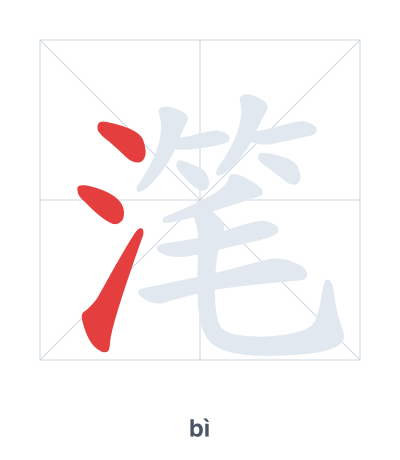
Open Hanzi Writer to see the animated stroke order and practice writing 滗 with real-time feedback.
The character 滗 (bì) is written with 13 strokes. Follow the standard Chinese stroke order: top to bottom, left to right, outside before inside. The radical 氵 is one of its key components.
Practice the correct stroke order with the Hanzi Writer app to see animated stroke-by-stroke guidance with real-time feedback.
滗 means to drain; to decant; to strain.
This compound character combines the water radical (氵) with 笔 (bǐ, brush). The brush suggests the action of pressing or filtering, as when you use a brush to push aside sediment while pouring off liquid, or the bristles act like a strainer to separate solids from liquid.
💡 Memory Tip: Imagine squeezing a wet brush (笔) to drain all the water (氵) out of it, straining the liquid through the bristles.
把菜里的水滗掉。
bǎ cài lǐ de shuǐ bì diào
Drain the water from the vegetables.
妈妈在滗药。
mā mā zài bì yào
Mom is straining the herbal medicine.
滗出锅里的汤。
bì chū guō lǐ de tāng
Drain the soup from the pot.
Open Hanzi Writer to see the animated stroke order and practice writing 滗 with real-time feedback.
✨ Animated stroke order · Handwriting recognition · HSK-graded practice · Free to use
滗 has the water radical 氵 on the left, indicating the meaning relates to liquid. The right side is 笔 (bǐ, meaning pen or brush), which gives a hint to the pronunciation and also suggests the action of pressing or squeezing like writing, which relates to draining liquid from solids.