Hanzi Writer

How to Write 妣 (bǐ) — Meaning “deceased mother”

7 strokes Radical: 女

妣 (bǐ) means "deceased mother" in Chinese. It has 7 strokes with the radical 女.

Rated 3.5/5 in difficulty (challenging).

Appears in 3+ common words including 先妣 (xiān bǐ), 考妣 (kǎo bǐ), 显妣 (xiǎn bǐ).

Due to its 7 strokes, Hanzi Writer's error detection shows 妣 requires focused practice — most learners need 10+ attempts for consistent accuracy.
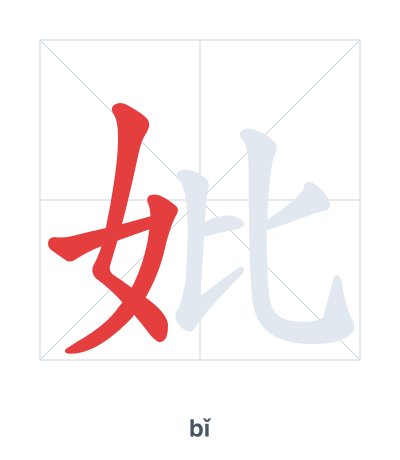
Stroke order practice for 妣 - bǐ

Practice Writing 妣 (bǐ)

Open Hanzi Writer to see the animated stroke order and practice writing 妣 with real-time feedback.

The character (bǐ) is written with 7 strokes. Follow the standard Chinese stroke order: top to bottom, left to right, outside before inside. The radical is one of its key components.

Practice the correct stroke order with the Hanzi Writer app to see animated stroke-by-stroke guidance with real-time feedback.

means deceased mother.

Character
Pinyinbǐ (bi)
Meaningdeceased mother
Strokes7
Radical
Difficulty3.5/5

Combines the radical 女 (woman, indicating mother) with 比 (bǐ, originally 'to compare' but used phonetically). In ancient Chinese ritual terms, 妣 specifically denotes a deceased mother, paired with 考 (kǎo) for deceased father.

💡 Memory Tip: Picture a woman (女) standing next to two crossed markers (比) like a tombstone, reminding you she is the deceased mother.

xiān bǐ
deceased mother
kǎo bǐ
Deceased father and mother.
xiǎn bǐ
Deceased mother (honorific)

这是先妣的墓。

zhè shì xiān bǐ de mù

This is the tomb of my late mother.

如丧考妣。

rú sàng kǎo bǐ

as if mourning one's own parents (extremely grieved)

显妣之墓。

xiǎn bǐ zhī mù

Tomb of my late mother.

Character Pinyin Strokes Radical
(current) 7
5
nǎi 5
jiān 6
Stroke order practice for 妣 - bǐ

Practice Writing 妣 (bǐ)

Open Hanzi Writer to see the animated stroke order and practice writing 妣 with real-time feedback.

✨ Animated stroke order · Handwriting recognition · HSK-graded practice · Free to use

Frequently Asked Questions about 妣

妣 is composed of the radical 女 (woman) on the left and the phonetic component 比 (bǐ) on the right. The 女 radical indicates the character relates to a female person, while 比 provides pronunciation. Together, they form the meaning of a deceased mother.

Characters with Radical 女

Other 7-Stroke Characters