鞴 (bèi) means "to harness a horse; bellows" in Chinese. It has 19 strokes with the radical 革.
Rated 4.2/5 in difficulty (advanced).
Appears in 3+ common words including 鞴马 (bèi mǎ), 鞴车 (bèi chē), 鞲鞴 (gōu bèi).
Due to its 19 strokes, Hanzi Writer's error detection shows 鞴 requires focused practice — most learners need 10+ attempts for consistent accuracy.
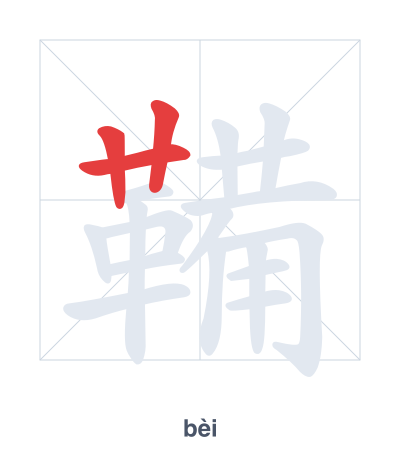
Open Hanzi Writer to see the animated stroke order and practice writing 鞴 with real-time feedback.
The character 鞴 (bèi) is written with 19 strokes. Follow the standard Chinese stroke order: top to bottom, left to right, outside before inside. The radical 革 is one of its key components.
Practice the correct stroke order with the Hanzi Writer app to see animated stroke-by-stroke guidance with real-time feedback.
鞴 means to harness a horse; bellows.
| Character | 鞴 |
| Pinyin | bèi (bei) |
| Meaning | to harness a horse; bellows |
| Strokes | 19 |
| Radical | 革 |
| Difficulty | 4.2/5 |
The character 鞴 combines the radical 革 (leather, representing horse gear) with the phonetic component 備 (bèi, meaning 'prepare' or 'equip'). This composition visually suggests the action of preparing leather gear to harness a horse, or the use of leather in constructing bellows.
💡 Memory Tip: Imagine a leather workshop where a horse is being fully equipped (備) with leather (革) harnesses and a set of bellows nearby to pump air for the forge.
他正在马厩里鞴马。
tā zhèng zài mǎ jiù lǐ bèi mǎ
He is saddling a horse in the stable.
我们要鞴车出发了。
wǒ men yào bèi chē chū fā le
We are going to harness the carriage and set off.
这个鞲鞴坏了。
zhè ge gōu bèi huài le
This piston is broken.
Open Hanzi Writer to see the animated stroke order and practice writing 鞴 with real-time feedback.
✨ Animated stroke order · Handwriting recognition · HSK-graded practice · Free to use
The character 鞴 is composed of 革 (leather) on the left and 用 (use) on the top with 冖 (cover) and 贝 (shell) below. The left radical 革 indicates the meaning relates to leather or animal hide, which connects to harnessing a horse with leather straps. The right side is a phonetic component giving the approximate sound bèi, though its original meaning is not directly related.