鞣 (róu) means "To tan (leather)" in Chinese. It has 18 strokes with the radical 革.
Rated 4.2/5 in difficulty (advanced).
Appears in 3+ common words including 鞣制 (róu zhì), 鞣酸 (róu suān), 鞣皮 (róu pí).
Due to its 18 strokes, Hanzi Writer's error detection shows 鞣 requires focused practice — most learners need 10+ attempts for consistent accuracy.
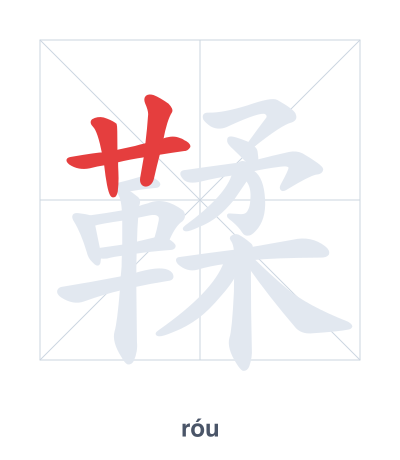
Open Hanzi Writer to see the animated stroke order and practice writing 鞣 with real-time feedback.
The character 鞣 (róu) is written with 18 strokes. Follow the standard Chinese stroke order: top to bottom, left to right, outside before inside. The radical 革 is one of its key components.
Practice the correct stroke order with the Hanzi Writer app to see animated stroke-by-stroke guidance with real-time feedback.
鞣 means To tan (leather).
| Character | 鞣 |
| Pinyin | róu (rou) |
| Meaning | To tan (leather) |
| Strokes | 18 |
| Radical | 革 |
| Difficulty | 4.2/5 |
The character 鞣 combines the radical 革 (leather/hide) on the left with 柔 (soft, pliable) on the right. This reflects the tanning process: treating raw hide to make it soft and workable.
💡 Memory Tip: Imagine a stiff leather hide (革) being massaged and softened (柔) like a flexible yoga mat until it's ready for use.
皮革需要经过鞣制。
pí gé xū yào jīng guò róu zhì
Leather needs to be tanned.
茶叶里含有鞣酸。
chá yè lǐ hán yǒu róu suān
Tea leaves contain tannic acid.
鞣皮是一项传统工艺。
róu pí shì yī xiàng chuán tǒng gōng yì
Tanning hides is a traditional craft.
Open Hanzi Writer to see the animated stroke order and practice writing 鞣 with real-time feedback.
✨ Animated stroke order · Handwriting recognition · HSK-graded practice · Free to use
The left side is 革 (gé), which means leather or hide. The right side is 柔 (róu), which means soft or flexible. Together, they suggest making leather soft through the tanning process.