蓓 (bèi) means "flower bud" in Chinese. It has 13 strokes with the radical 艹.
Rated 4.2/5 in difficulty (advanced).
Appears in 3+ common words including 蓓蕾 (bèi lěi), 蓓蕾期 (bèi lěi qī), 蓓蕾初绽 (bèi lěi chū zhàn).
Due to its 13 strokes, Hanzi Writer's error detection shows 蓓 requires focused practice — most learners need 10+ attempts for consistent accuracy.
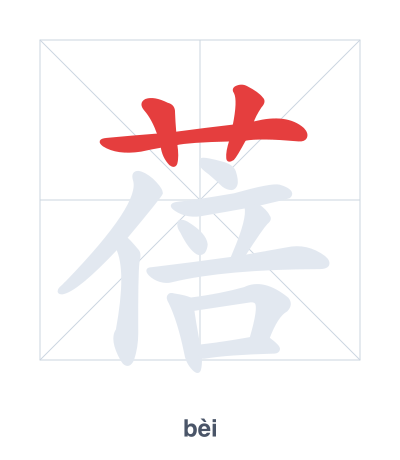
Open Hanzi Writer to see the animated stroke order and practice writing 蓓 with real-time feedback.
The character 蓓 (bèi) is written with 13 strokes. Follow the standard Chinese stroke order: top to bottom, left to right, outside before inside. The radical 艹 is one of its key components.
Practice the correct stroke order with the Hanzi Writer app to see animated stroke-by-stroke guidance with real-time feedback.
蓓 means flower bud.
蓓 is a phono-semantic compound combining the grass radical 艹 (indicating plants) with 咅 (pǒu), which contributes the sound. The character specifically denotes a flower bud, the unopened bloom still wrapped in protective leaves.
💡 Memory Tip: Picture a grass-covered bud (艹) that looks like a tiny 'B' shape (for bèi) waiting to blossom into a beautiful flower.
花枝上结满了蓓蕾。
huā zhī shàng jié mǎn le bèi lěi
The flower branches are full of buds.
这些花正处于蓓蕾期。
zhè xiē huā zhèng chǔ yú bèi lěi qī
These flowers are in the budding stage.
春天到了,蓓蕾初绽。
chūn tiān dào le bèi lěi chū zhàn
Spring has arrived, and the buds are beginning to bloom.
Open Hanzi Writer to see the animated stroke order and practice writing 蓓 with real-time feedback.
✨ Animated stroke order · Handwriting recognition · HSK-graded practice · Free to use
蓓 is composed of the radical 艹 (grass) on top and the character 倍 (bèi, meaning 'double' or 'multiple') below. The grass radical indicates it relates to plants, and 倍 suggests the layered petals of a flower bud that will multiply when blooming.