梆 (bāng) means "Wooden clapper" in Chinese. It has 10 strokes with the radical 木.
Rated 4.2/5 in difficulty (advanced).
Appears in 3+ common words including 梆子 (bāng zi), 梆梆声 (bāng bāng shēng), 梆硬 (bāng yìng).
Due to its 10 strokes, Hanzi Writer's error detection shows 梆 requires focused practice — most learners need 10+ attempts for consistent accuracy.
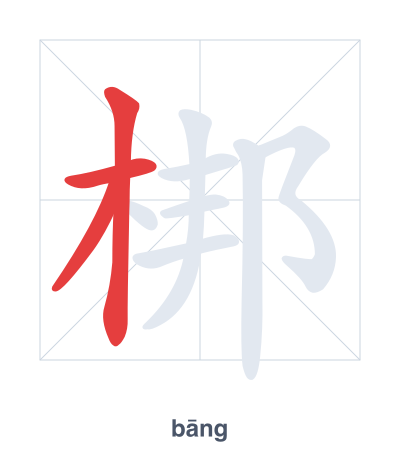
Open Hanzi Writer to see the animated stroke order and practice writing 梆 with real-time feedback.
The character 梆 (bāng) is written with 10 strokes. Follow the standard Chinese stroke order: top to bottom, left to right, outside before inside. The radical 木 is one of its key components.
Practice the correct stroke order with the Hanzi Writer app to see animated stroke-by-stroke guidance with real-time feedback.
梆 means Wooden clapper.
梆 is a phonetic compound: the radical 木 (wood) indicates the material, while 邦 (bāng, meaning 'state' or 'country') provides the pronunciation. It depicts a wooden clapper historically used by night watchmen or in traditional opera to keep rhythm.
💡 Memory Tip: Imagine a wooden clapper (木) shaped like a tiny country (邦) that goes 'bāng' when you hit it.
他在敲梆子。
tā zài qiāo bāng zi
He is beating the wooden clappers.
传来阵阵梆梆声。
chuán lái zhèn zhèn bāng bāng shēng
The rhythmic sound of wooden clappers was heard.
这块馒头梆硬。
zhè kuài mán tou bāng yìng
This steamed bun is rock hard.
Open Hanzi Writer to see the animated stroke order and practice writing 梆 with real-time feedback.
✨ Animated stroke order · Handwriting recognition · HSK-graded practice · Free to use
The character 梆 is composed of the radical 木 (wood) on the left and the phonetic component 邦 (bāng) on the right. The wood radical indicates that the object is made of wood, while 邦 provides the pronunciation. Together, they form a word for a wooden clapper used in traditional Chinese music or as a watchman's tool.