坂 (bǎn) means "Slope / Hillside" in Chinese. It has 7 strokes with the radical 土.
Rated 3.5/5 in difficulty (challenging).
Appears in 3+ common words including 大阪 (dà bǎn), 山坂 (shān bǎn), 坂道 (bǎn dào).
Due to its 7 strokes, Hanzi Writer's error detection shows 坂 requires focused practice — most learners need 10+ attempts for consistent accuracy.
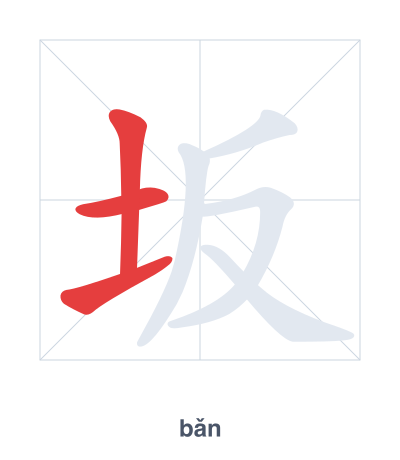
Open Hanzi Writer to see the animated stroke order and practice writing 坂 with real-time feedback.
The character 坂 (bǎn) is written with 7 strokes. Follow the standard Chinese stroke order: top to bottom, left to right, outside before inside. The radical 土 is one of its key components.
Practice the correct stroke order with the Hanzi Writer app to see animated stroke-by-stroke guidance with real-time feedback.
坂 means Slope / Hillside.
The character 坂 combines the radical 土 (earth/land) on the left with 反 (fǎn, meaning 'reverse' or 'opposite') on the right. 反 provides both a phonetic hint and a semantic suggestion of a slanted or turned surface, together indicating a slope or hillside of earth.
💡 Memory Tip: Picture a hillside of earth (土) so steep you have to reverse (反) direction to climb it.
他去过大阪旅游。
tā qù guò dà bǎn lǚ yóu
He has been to Osaka for a trip.
山坂上有很多树。
shān bǎn shàng yǒu hěn duō shù
There are many trees on the hillside.
这条坂道很陡。
zhè tiáo bǎn dào hěn dǒu
This sloping road is very steep.
Open Hanzi Writer to see the animated stroke order and practice writing 坂 with real-time feedback.
✨ Animated stroke order · Handwriting recognition · HSK-graded practice · Free to use
坂 is made of two parts: the radical 土 (earth) on the left and 反 (anti/opposite) on the right. The left radical 土 suggests soil or ground, while 反 here hints at a slanting or inverted surface, together meaning a slope or hillside.