菝 (bá) means "smilax (a type of vine)" in Chinese. It has 11 strokes with the radical 艹.
Rated 4.2/5 in difficulty (advanced).
Appears in 3+ common words including 菝葜 (bá qiā), 菝葜根 (bá qiā gēn), 菝葜叶 (bá qiā yè).
Due to its 11 strokes, Hanzi Writer's error detection shows 菝 requires focused practice — most learners need 10+ attempts for consistent accuracy.
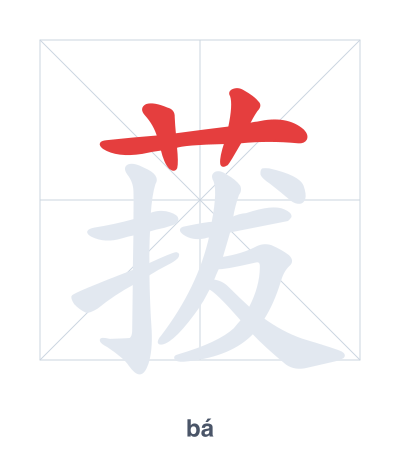
Open Hanzi Writer to see the animated stroke order and practice writing 菝 with real-time feedback.
The character 菝 (bá) is written with 11 strokes. Follow the standard Chinese stroke order: top to bottom, left to right, outside before inside. The radical 艹 is one of its key components.
Practice the correct stroke order with the Hanzi Writer app to see animated stroke-by-stroke guidance with real-time feedback.
菝 means smilax (a type of vine).
菝 is a phono-semantic compound with 艹 (grass) indicating it's a plant, and 拔 (bá, 'to pull') as the sound component. The character refers to smilax, a thorny climbing vine that can 'pull' or snag onto other plants and clothing.
💡 Memory Tip: Imagine a grass (艹) vine that you try to pull (拔) but it's covered in thorns, so you shout 'Bá!' in pain.
这种植物叫菝葜。
zhè zhòng zhí wù jiào bá qiā
This plant is called sarsaparilla.
菝葜根可以入药。
bá qiā gēn kě yǐ rù yào
Smilax root can be used as medicine.
菝葜叶是绿色的。
bá qiā yè shì lǜ sè de
Smilax leaves are green.
Open Hanzi Writer to see the animated stroke order and practice writing 菝 with real-time feedback.
✨ Animated stroke order · Handwriting recognition · HSK-graded practice · Free to use
菝 is formed by the grass radical 艹 on top and the phonetic component 拔 (bá) below. The grass radical indicates it is a plant, while 拔 gives the pronunciation and hints at the vine's climbing or pulling nature. Together they represent the smilax vine, a type of thorny climbing plant.