霭 (ǎi) means "Mist or haze" in Chinese. It has 19 strokes with the radical 雨.
Rated 4.2/5 in difficulty (advanced).
Appears in 3+ common words including 暮霭 (mù ǎi), 烟霭 (yān ǎi), 云霭 (yún ǎi).
Due to its 19 strokes, Hanzi Writer's error detection shows 霭 requires focused practice — most learners need 10+ attempts for consistent accuracy.
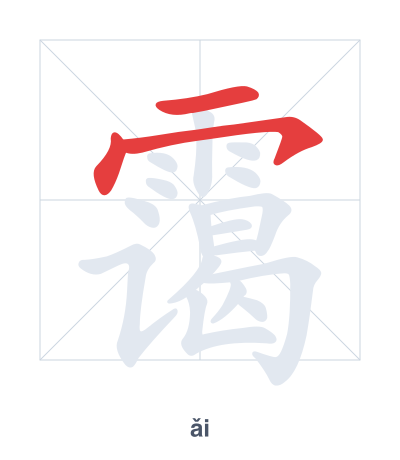
Open Hanzi Writer to see the animated stroke order and practice writing 霭 with real-time feedback.
The character 霭 (ǎi) is written with 19 strokes. Follow the standard Chinese stroke order: top to bottom, left to right, outside before inside. The radical 雨 is one of its key components.
Practice the correct stroke order with the Hanzi Writer app to see animated stroke-by-stroke guidance with real-time feedback.
霭 means Mist or haze.
霭 is a compound character: the radical 雨 (rain) indicates a weather phenomenon, while the phonetic component 曷 (hé) originally meant 'to stop' or 'to question,' but here it gives the sound and suggests how haze halts clear vision. Together, they depict mist or haze that hangs in the air, like frozen raindrops.
💡 Memory Tip: Imagine rain (雨) stopping mid-air in a thick haze, and you squint and ask 'Why?' (曷) can't I see through it?
暮霭笼罩着山林。
mù ǎi lǒng zhào zhe shān lín
Evening mist shrouded the mountains and forests.
湖面上有一层烟霭。
hú miàn shàng yǒu yī céng yān ǎi
There is a layer of mist on the lake.
云霭在山间飘动。
yún ǎi zài shān jiān piāo dòng
Mist floats among the mountains.
Open Hanzi Writer to see the animated stroke order and practice writing 霭 with real-time feedback.
✨ Animated stroke order · Handwriting recognition · HSK-graded practice · Free to use
The character 霭 is composed of the radical 雨 (rain) on top, indicating weather or atmospheric phenomena. The bottom part is 曷, which provides a phonetic hint (though the pronunciation ǎi differs slightly from 曷's hé). Together, 雨 + 曷 create the idea of a misty or hazy condition in the air.