诅 (zǔ) means "To curse" in Chinese. It has 7 strokes with the radical 讠.
Rated 3.2/5 in difficulty (challenging).
Appears in 3+ common words including 诅咒 (zǔ zhòu), 咒诅 (zhòu zǔ), 诅骂 (zǔ mà).
Due to its 7 strokes, Hanzi Writer's error detection shows 诅 requires focused practice — most learners need 10+ attempts for consistent accuracy.
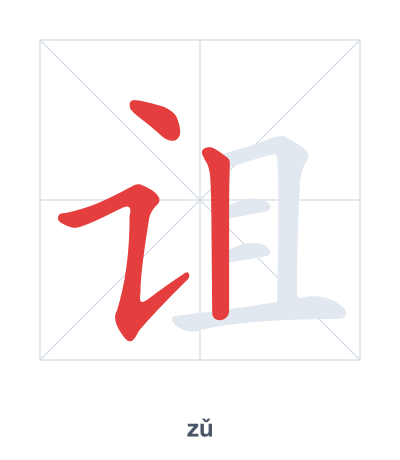
Open Hanzi Writer to see the animated stroke order and practice writing 诅 with real-time feedback.
The character 诅 (zǔ) is written with 7 strokes. Follow the standard Chinese stroke order: top to bottom, left to right, outside before inside. The radical 讠 is one of its key components.
Practice the correct stroke order with the Hanzi Writer app to see animated stroke-by-stroke guidance with real-time feedback.
诅 means To curse.
诅 combines the speech radical 讠 (words) with 且 (zǔ) as a phonetic component. It originally meant to utter a curse or imprecation, often by invoking spirits or ancestors.
💡 Memory Tip: Picture a speaker (讠) shouting 'ZOO!' while pointing at a tombstone (且) to curse the deceased's family.
他在心里诅咒坏人。
tā zài xīn lǐ zǔ zhòu huài rén
He is cursing the bad guys in his heart.
这种咒诅非常可怕。
zhè zhǒng zhòu zǔ fēi cháng kě pà
This curse is very terrifying.
他愤怒地大声诅骂。
tā fèn nù dì dà shēng zǔ mà
He cursed loudly in anger.
Open Hanzi Writer to see the animated stroke order and practice writing 诅 with real-time feedback.
✨ Animated stroke order · Handwriting recognition · HSK-graded practice · Free to use
The character 诅 is formed by the radical 讠, meaning "speech," on the left, and 且 on the right, which provides the sound. Because curses are expressed through spoken words, the speech radical directly connects to the meaning of "to curse."