秭 (zǐ) means "septillion (10^24)" in Chinese. It has 9 strokes with the radical 禾.
Rated 4/5 in difficulty (challenging).
Appears in 3+ common words including 秭归 (zǐ guī), 万秭 (wàn zǐ), 秭妹 (zǐ mèi).
Due to its 9 strokes, Hanzi Writer's error detection shows 秭 requires focused practice — most learners need 10+ attempts for consistent accuracy.
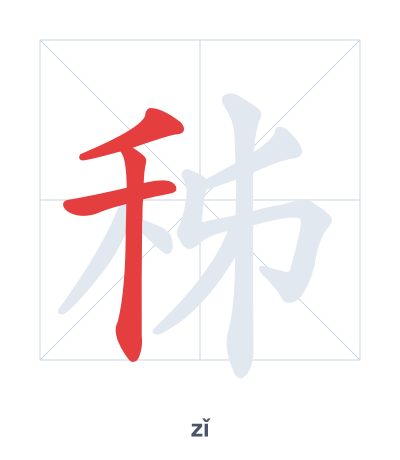
Open Hanzi Writer to see the animated stroke order and practice writing 秭 with real-time feedback.
The character 秭 (zǐ) is written with 9 strokes. Follow the standard Chinese stroke order: top to bottom, left to right, outside before inside. The radical 禾 is one of its key components.
Practice the correct stroke order with the Hanzi Writer app to see animated stroke-by-stroke guidance with real-time feedback.
秭 means septillion (10^24).
This is a phono-semantic compound. The radical 禾 (grain) suggests counting or a large quantity of grains, while the right component 亓 (qí) provides the pronunciation. Together, 秭 originally denoted a very large number, specifically septillion (10^24), used in ancient Chinese numerical systems.
💡 Memory Tip: Picture a grain stalk (禾) with a giant tally mark (亓) scratched into it, each notch representing a factor of 10, adding up to a septillion grains.
秭归在湖北省。
zǐ guī zài hú běi shěng
Zigui is in Hubei Province.
这是一个大数目。
zhè shì yí gè dà shù mù
This is a large amount.
秭妹情深。
zǐ mèi qíng shēn
The bond between sisters is deep.
Open Hanzi Writer to see the animated stroke order and practice writing 秭 with real-time feedback.
✨ Animated stroke order · Handwriting recognition · HSK-graded practice · Free to use
秭 is composed of the radical 禾 (grain) on the left and 弟 (younger brother) on the right. The radical suggests a connection to grain or numbers, while 弟 provides the sound (zǐ) and hints at order — together they form a word for a huge number, like counting grains beyond imagination.