淄 (zī) means "Zi (name of a river and place)" in Chinese. It has 11 strokes with the radical 氵.
Rated 4.2/5 in difficulty (advanced).
Appears in 3+ common words including 淄博 (zī bó), 淄川 (zī chuān), 淄水 (zī shuǐ).
Due to its 11 strokes, Hanzi Writer's error detection shows 淄 requires focused practice — most learners need 10+ attempts for consistent accuracy.
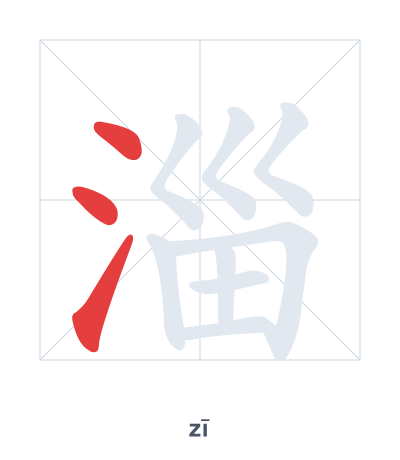
Open Hanzi Writer to see the animated stroke order and practice writing 淄 with real-time feedback.
The character 淄 (zī) is written with 11 strokes. Follow the standard Chinese stroke order: top to bottom, left to right, outside before inside. The radical 氵 is one of its key components.
Practice the correct stroke order with the Hanzi Writer app to see animated stroke-by-stroke guidance with real-time feedback.
淄 means Zi (name of a river and place).
淄 is a phono-semantic compound combining the water radical (氵) with the phonetic component 甾 (zāi), which originally depicted a vessel or container. The character names the Zi River in Shandong, emphasizing its flowing water, while 甾 provides the sound and hints at the river's role in irrigating fertile fields.
💡 Memory Tip: Picture a river (氵) winding through a field of grain (田), with a zigzagging path (the 巛 above) that looks like the river's own swirling currents.
淄博的烧烤非常有名。
zī bó de shāo kǎo fēi cháng yǒu míng
Zibo barbecue is very famous.
他的家乡在淄川。
tā de jiā xiāng zài zī chuān
His hometown is in Zichuan.
淄水流经这个小镇。
zī shuǐ liú jīng zhè ge xiǎo zhèn
The Zi River flows through this small town.
Open Hanzi Writer to see the animated stroke order and practice writing 淄 with real-time feedback.
✨ Animated stroke order · Handwriting recognition · HSK-graded practice · Free to use
The character 淄 is made of the water radical 氵 on the left and the phonetic component 甾 (zī) on the right. The water radical indicates that 淄 originally refers to a river or place with water, which matches its use in the Zi River and cities in Shandong.