洙 (zhū) means "Zhu (name of a river)" in Chinese. It has 9 strokes with the radical 氵.
Rated 4/5 in difficulty (challenging).
Appears in 3+ common words including 洙泗 (zhū sì), 洙水 (zhū shuǐ), 洙泗之风 (zhū sì zhī fēng).
Due to its 9 strokes, Hanzi Writer's error detection shows 洙 requires focused practice — most learners need 10+ attempts for consistent accuracy.
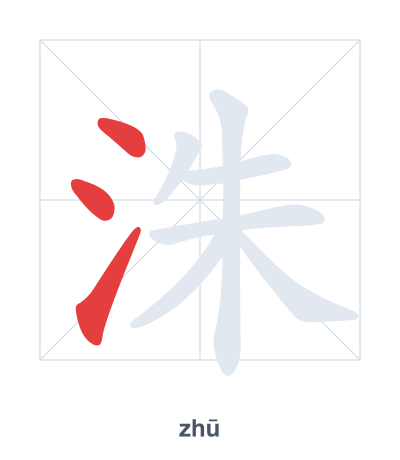
Open Hanzi Writer to see the animated stroke order and practice writing 洙 with real-time feedback.
The character 洙 (zhū) is written with 9 strokes. Follow the standard Chinese stroke order: top to bottom, left to right, outside before inside. The radical 氵 is one of its key components.
Practice the correct stroke order with the Hanzi Writer app to see animated stroke-by-stroke guidance with real-time feedback.
洙 means Zhu (name of a river).
洙 is a phono-semantic compound: the radical 氵 (water) indicates it's a river, while 朱 (zhū, meaning 'red') provides pronunciation. It names the Zhu River, an ancient waterway in Shandong, China.
💡 Memory Tip: Picture a river (氵) stained red (朱) by cinnabar, and a signpost reading 'Zhu River'.
洙泗是孔子的故乡。
zhū sì shì kǒng zi de gù xiāng
Zhu and Si are in Confucius's hometown.
洙水流向远方。
zhū shuǐ liú xiàng yuǎn fāng
The Zhu River flows into the distance.
这里有洙泗之风。
zhè lǐ yǒu zhū sì zhī fēng
There is a scholarly atmosphere of Confucius and Mencius here.
Open Hanzi Writer to see the animated stroke order and practice writing 洙 with real-time feedback.
✨ Animated stroke order · Handwriting recognition · HSK-graded practice · Free to use
洙 is composed of the water radical 氵 on the left and 朱 (zhū, a phonetic component) on the right. The water radical indicates that the character refers to a river, while 朱 provides the pronunciation and originally may have been linked to a place name. Together, they form the name of the Zhu River.