忮 (zhì) means "jealous; stubborn; aggressive" in Chinese. It has 7 strokes with the radical 忄.
Rated 3.5/5 in difficulty (challenging).
Appears in 3+ common words including 不忮不求 (bù zhì bù qiú), 忮刻 (zhì kè), 忮求 (zhì qiú).
Due to its 7 strokes, Hanzi Writer's error detection shows 忮 requires focused practice — most learners need 10+ attempts for consistent accuracy.
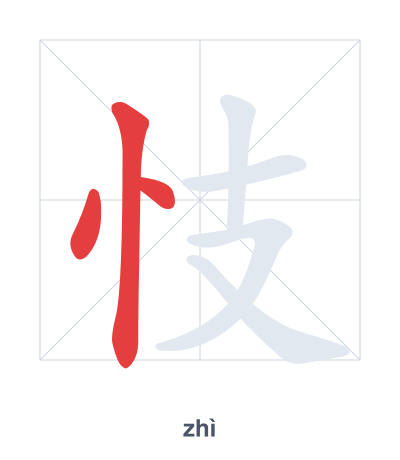
Open Hanzi Writer to see the animated stroke order and practice writing 忮 with real-time feedback.
The character 忮 (zhì) is written with 7 strokes. Follow the standard Chinese stroke order: top to bottom, left to right, outside before inside. The radical 忄 is one of its key components.
Practice the correct stroke order with the Hanzi Writer app to see animated stroke-by-stroke guidance with real-time feedback.
忮 means jealous; stubborn; aggressive.
忮 is a phono-semantic compound where the radical 忄 (heart) represents emotions, and 支 (zhī) provides the sound while also suggesting a branch poking outward, evoking the aggressive, jealous mindset.
💡 Memory Tip: Imagine a jealous heart (忄) getting poked by a sharp branch (支), making it stubborn and aggressive.
他过着不忮不求的生活。
tā guò zhe bù zhì bù qiú de shēng huó
He lives a life free from envy and greed.
他的性格有些忮刻。
tā de xìng gé yǒu xiē zhì kè
He has a somewhat jealous and cruel personality.
为人不可贪功忮求。
wéi rén bù kě tān gōng zhì qiú
One should not be greedy for credit or envious.
Open Hanzi Writer to see the animated stroke order and practice writing 忮 with real-time feedback.
✨ Animated stroke order · Handwriting recognition · HSK-graded practice · Free to use
忮 (zhì) combines the radical 忄 (heart/mind) on the left with 支 (zhī, branch) on the right. The heart radical suggests emotions or attitudes, while 支 hints at separation or branching out, together implying a heart that is "branching off" into negative emotions like jealousy or stubbornness.