轵 (zhǐ) means "End of an axle" in Chinese. It has 9 strokes with the radical 车.
Rated 4/5 in difficulty (challenging).
Appears in 3+ common words including 轵道 (zhǐ dào), 轵首 (zhǐ shǒu), 轵里 (zhǐ lǐ).
Due to its 9 strokes, Hanzi Writer's error detection shows 轵 requires focused practice — most learners need 10+ attempts for consistent accuracy.
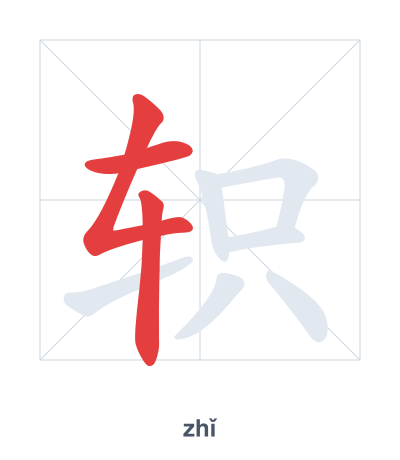
Open Hanzi Writer to see the animated stroke order and practice writing 轵 with real-time feedback.
The character 轵 (zhǐ) is written with 9 strokes. Follow the standard Chinese stroke order: top to bottom, left to right, outside before inside. The radical 车 is one of its key components.
Practice the correct stroke order with the Hanzi Writer app to see animated stroke-by-stroke guidance with real-time feedback.
轵 means End of an axle.
轵 is a phono-semantic compound: the radical 车 (vehicle) suggests an axle component, while 只 (zhǐ) provides the pronunciation. The character specifically refers to the metal cap or stop at the end of an axle, which prevents the wheel from sliding off.
💡 Memory Tip: Picture the axle of a chariot (车) with only one (只) small cap at its very end, holding the wheel in place.
轵道是一个古地名。
zhǐ dào shì yí gè gǔ dì míng
Zhidao is an ancient place name.
轵首是车轴的一端。
zhǐ shǒu shì chē zhóu de yī duān
Zhishou is one end of a carriage axle.
他住在轵里。
tā zhù zài zhǐ lǐ
He lives in Zhili.
Open Hanzi Writer to see the animated stroke order and practice writing 轵 with real-time feedback.
✨ Animated stroke order · Handwriting recognition · HSK-graded practice · Free to use
The character 轵 combines the radical 车 (chē, meaning 'vehicle') on the left and 只 (zhǐ) on the right. The radical 车 indicates the character relates to vehicles, and the right side 只 provides a phonetic hint for pronunciation zhǐ. Together, they represent 'the end of an axle,' a specific part of a carriage.