怔 (zhēng/zhèng) means "stunned; dazed" in Chinese. It has 8 strokes with the radical 忄.
Rated 3.7/5 in difficulty (challenging).
Appears in 3+ common words including 发怔 (fā zhèng), 怔住 (zhèng zhù), 怔怔 (zhēng zhēng).
Due to its 8 strokes, Hanzi Writer's error detection shows 怔 requires focused practice — most learners need 10+ attempts for consistent accuracy.
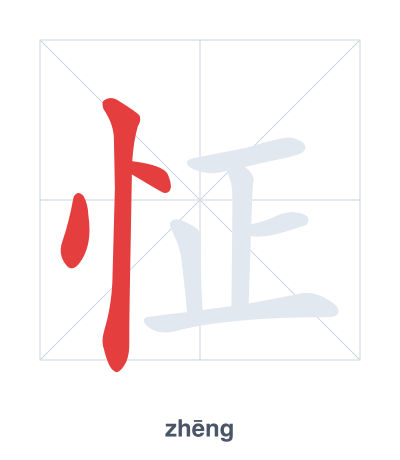
Open Hanzi Writer to see the animated stroke order and practice writing 怔 with real-time feedback.
The character 怔 (zhēng/zhèng) is written with 8 strokes. Follow the standard Chinese stroke order: top to bottom, left to right, outside before inside. The radical 忄 is one of its key components.
Practice the correct stroke order with the Hanzi Writer app to see animated stroke-by-stroke guidance with real-time feedback.
怔 means stunned; dazed.
This is a polyphonic character with readings: zhēng, zhèng.
怔 is a phono-semantic compound: the radical 忄 (heart) indicates the mind or emotions, while 正 (zhèng, 'correct/straight') provides the pronunciation and suggests a fixed, rigid state—like the mind frozen in shock or dazedness.
💡 Memory Tip: Picture a heart (忄) suddenly turning stiff and straight (正) like a frozen board, completely stunned.
他坐在那儿发怔。
tā zuò zài nà ér fā zhèng
He is sitting there in a daze.
听到消息他怔住了。
tīng dào xiāo xī tā zhèng zhù le
He was stunned upon hearing the news.
他怔怔地看着窗外。
tā zhēng zhēng dì kàn zhe chuāng wài
He stared blankly out the window.
Open Hanzi Writer to see the animated stroke order and practice writing 怔 with real-time feedback.
✨ Animated stroke order · Handwriting recognition · HSK-graded practice · Free to use
怔 has two parts: the radical 忄 (heart/mind) on the left and 正 (zhèng, meaning 'correct' or 'straight') on the right. The heart radical suggests a mental or emotional state, while 正 hints at being 'fixed' or 'stopped' — together they show the mind suddenly becoming still or blank, resulting in a dazed feeling.