桢 (zhēn) means "Evergreen tree / Post" in Chinese. It has 10 strokes with the radical 木.
Rated 4.2/5 in difficulty (advanced).
Appears in 3+ common words including 桢楠 (zhēn nán), 桢木 (zhēn mù), 桢干 (zhēn gàn).
Due to its 10 strokes, Hanzi Writer's error detection shows 桢 requires focused practice — most learners need 10+ attempts for consistent accuracy.
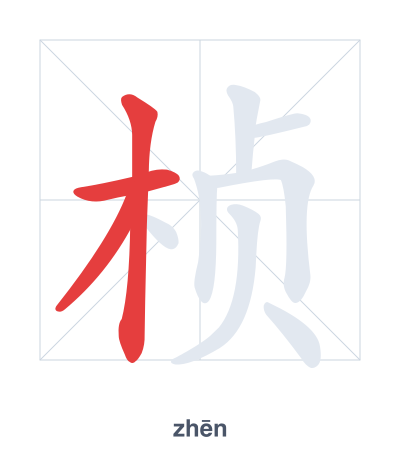
Open Hanzi Writer to see the animated stroke order and practice writing 桢 with real-time feedback.
The character 桢 (zhēn) is written with 10 strokes. Follow the standard Chinese stroke order: top to bottom, left to right, outside before inside. The radical 木 is one of its key components.
Practice the correct stroke order with the Hanzi Writer app to see animated stroke-by-stroke guidance with real-time feedback.
桢 means Evergreen tree / Post.
This character combines the tree radical 木 with the phonetic component 贞 (zhēn, meaning 'chaste' or 'pure'), indicating both sound and a sense of uprightness. Originally referring to an evergreen tree, it later came to mean a wooden post or pillar used in construction, reflecting the tree's sturdy, vertical nature.
💡 Memory Tip: Picture a strong evergreen tree (木) standing as a pure, upright post (贞) in a sacred courtyard.
桢楠是名贵木材。
zhēn nán shì míng guì mù cái
Zhennan is a precious type of wood.
桢木质地很硬。
zhēn mù zhì dì hěn yìng
Zhenmu wood has a very hard texture.
他是国家的桢干。
tā shì guó jiā de zhēn gàn
He is a backbone of the country.
Open Hanzi Writer to see the animated stroke order and practice writing 桢 with real-time feedback.
✨ Animated stroke order · Handwriting recognition · HSK-graded practice · Free to use
桢 has the radical 木 (wood/tree) on the left and 贞 (zhēn, meaning chaste or upright) on the right. The wood radical shows that 桢 is a type of tree, while 贞 adds a hint of strength and uprightness, matching the idea of an evergreen tree used for strong pillars.