楠 (nán) means "nanmu (a type of wood)" in Chinese. It has 13 strokes with the radical 木.
Rated 4.2/5 in difficulty (advanced).
Appears in 3+ common words including 楠木 (nán mù), 金丝楠 (jīn sī nán), 楠竹 (nán zhú).
Due to its 13 strokes, Hanzi Writer's error detection shows 楠 requires focused practice — most learners need 10+ attempts for consistent accuracy.
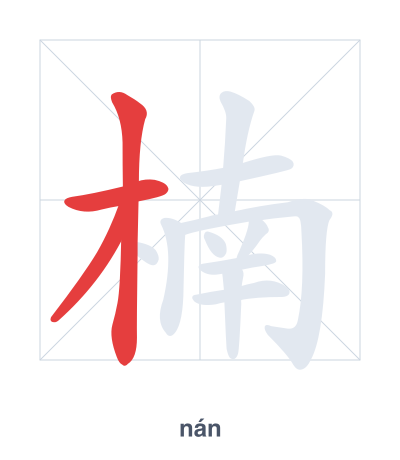
Open Hanzi Writer to see the animated stroke order and practice writing 楠 with real-time feedback.
The character 楠 (nán) is written with 13 strokes. Follow the standard Chinese stroke order: top to bottom, left to right, outside before inside. The radical 木 is one of its key components.
Practice the correct stroke order with the Hanzi Writer app to see animated stroke-by-stroke guidance with real-time feedback.
楠 means nanmu (a type of wood).
楠 is a compound character with the radical 木 (tree/wood) on the left, indicating it is a type of tree. The right side 南 (south) provides phonetic and semantic clues, as the nanmu tree was historically associated with southern regions of China, where its valuable, fragrant wood was harvested.
💡 Memory Tip: Imagine a huge nanmu tree in the south, with its sturdy trunk shaped like the character 南, standing tall beside the wood radical 木.
这张桌子是楠木做的。
zhè zhāng zhuō zi shì nán mù zuò de
This table is made of nanmu wood.
金丝楠非常名贵。
jīn sī nán fēi cháng míng guì
Phoebe zhennan is very precious.
山上有很多楠竹。
shān shàng yǒu hěn duō nán zhú
There are many Moso bamboos on the mountain.
Open Hanzi Writer to see the animated stroke order and practice writing 楠 with real-time feedback.
✨ Animated stroke order · Handwriting recognition · HSK-graded practice · Free to use
The character 楠 is made of the radical 木 (wood) on the left, which shows it is related to trees or wood. The right part 南 (south) gives the pronunciation "nán" and also hints that nanmu trees grow in southern China. Together, the structure tells you this is a type of wood from the south.