诏 (zhào) means "Imperial edict; to summon by decree" in Chinese. It has 7 strokes with the radical 讠.
Rated 3.2/5 in difficulty (challenging).
Appears in 3+ common words including 诏书 (zhào shū), 下诏 (xià zhào), 诏令 (zhào lìng).
Due to its 7 strokes, Hanzi Writer's error detection shows 诏 requires focused practice — most learners need 10+ attempts for consistent accuracy.
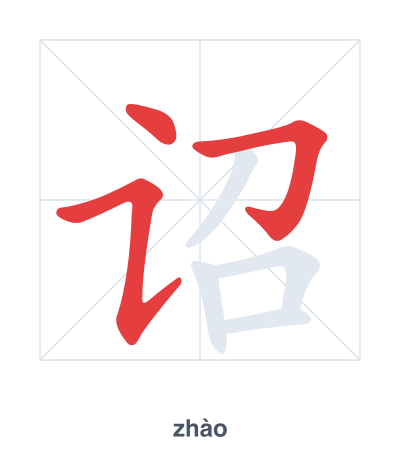
Open Hanzi Writer to see the animated stroke order and practice writing 诏 with real-time feedback.
The character 诏 (zhào) is written with 7 strokes. Follow the standard Chinese stroke order: top to bottom, left to right, outside before inside. The radical 讠 is one of its key components.
Practice the correct stroke order with the Hanzi Writer app to see animated stroke-by-stroke guidance with real-time feedback.
诏 means Imperial edict; to summon by decree.
诏 is a compound character combining the radical 讠 (speech/words) with 召 (to summon). 召 itself consists of 刀 (knife) and 口 (mouth), originally picturing a call issued with authority. Together, 诏 conveys the idea of an official spoken command, specifically an imperial edict or decree issued by the emperor.
💡 Memory Tip: Picture the emperor slashing a knife (刀) through a scroll while his mouth (口) speaks (讠) the imperial decree that summons everyone.
皇帝写了一封诏书。
huáng dì xiě le yī fēng zhào shū
The Emperor wrote an imperial edict.
皇帝下诏大赦天下。
huáng dì xià zhào dà shè tiān xià
The Emperor issued a decree granting a general amnesty.
这是古代的诏令。
zhè shì gǔ dài de zhào lìng
This is an ancient imperial edict.
Open Hanzi Writer to see the animated stroke order and practice writing 诏 with real-time feedback.
✨ Animated stroke order · Handwriting recognition · HSK-graded practice · Free to use
诏 is composed of the radical 讠 (speech) on the left and the phonetic component 召 (zhào, to summon) on the right. The speech radical indicates that the character relates to spoken or written language, while 召 gives the sound and hints at the idea of summoning. Together, they form the meaning 'imperial edict' or 'to summon by decree'.