棹 (zhào) means "Oar or paddle" in Chinese. It has 12 strokes with the radical 木.
Rated 4.2/5 in difficulty (advanced).
Appears in 3+ common words including 船棹 (chuán zhào), 划棹 (huà zhào), 归棹 (guī zhào).
Due to its 12 strokes, Hanzi Writer's error detection shows 棹 requires focused practice — most learners need 10+ attempts for consistent accuracy.
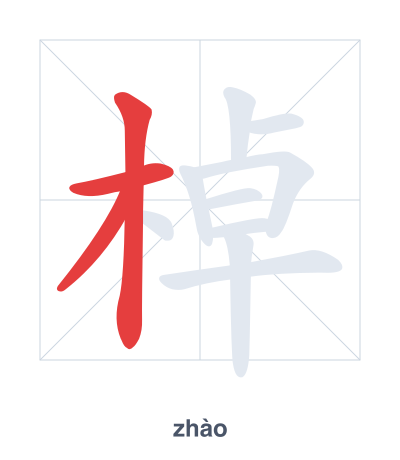
Open Hanzi Writer to see the animated stroke order and practice writing 棹 with real-time feedback.
The character 棹 (zhào) is written with 12 strokes. Follow the standard Chinese stroke order: top to bottom, left to right, outside before inside. The radical 木 is one of its key components.
Practice the correct stroke order with the Hanzi Writer app to see animated stroke-by-stroke guidance with real-time feedback.
棹 means Oar or paddle.
棹 is a phono-semantic compound: the radical 木 (wood/tree) indicates it's made of wood, while 卓 (zhào, meaning 'tall' or 'eminent') provides the pronunciation and hints at the oar's long, upright shape used to paddle a boat.
💡 Memory Tip: Picture a tall wooden pole (木) with a 'table' (卓) for a blade, standing upright like an oar in a boat.
船棹掉进水里了。
chuán zhào diào jìn shuǐ lǐ le
The oar fell into the water.
他在湖里划棹。
tā zài hú lǐ huà zhào
He is rowing an oar in the lake.
远方传来了归棹声。
yuǎn fāng chuán lái le guī zhào shēng
The sound of returning oars came from afar.
Open Hanzi Writer to see the animated stroke order and practice writing 棹 with real-time feedback.
✨ Animated stroke order · Handwriting recognition · HSK-graded practice · Free to use
棹 is made of the radical 木 (wood) on the left and 卓 on the right. The 木 suggests the character relates to wood, and 卓 gives the sound. Together, they form the meaning 'oar,' a wooden tool used for rowing.