郓 (yùn) means "Yun (a surname / place name)" in Chinese. It has 8 strokes with the radical 阝.
Rated 3.4/5 in difficulty (challenging).
Appears in 3+ common words including 郓城 (yùn chéng), 郓先生 (yùn xiān shēng), 郓州 (yùn zhōu).
Due to its 8 strokes, Hanzi Writer's error detection shows 郓 requires focused practice — most learners need 10+ attempts for consistent accuracy.
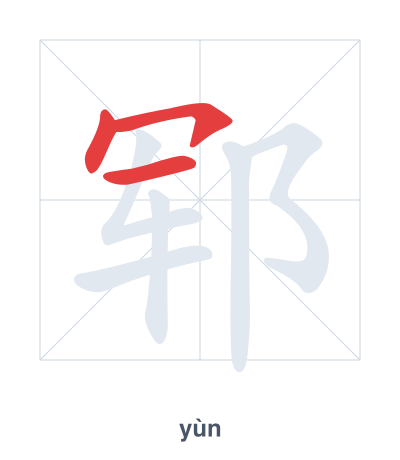
Open Hanzi Writer to see the animated stroke order and practice writing 郓 with real-time feedback.
The character 郓 (yùn) is written with 8 strokes. Follow the standard Chinese stroke order: top to bottom, left to right, outside before inside. The radical 阝 is one of its key components.
Practice the correct stroke order with the Hanzi Writer app to see animated stroke-by-stroke guidance with real-time feedback.
郓 means Yun (a surname / place name).
郓 combines 阝 (city) with 军 (army), originally referring to a walled city associated with military forces. It was the name of an ancient state in present-day Shandong, later adopted as a surname.
💡 Memory Tip: Imagine an army (军) marching into a walled city (阝) called Yun.
郓城在山东省。
yùn chéng zài shān dōng shěng
Yuncheng is in Shandong Province.
郓先生正在看书。
yùn xiān shēng zhèng zài kàn shū
Mr. Yun is reading a book.
郓州是古代的地名。
yùn zhōu shì gǔ dài de dì míng
Yunzhou is an ancient place name.
Open Hanzi Writer to see the animated stroke order and practice writing 郓 with real-time feedback.
✨ Animated stroke order · Handwriting recognition · HSK-graded practice · Free to use
郓 is made of two parts: the left radical 阝 (meaning a hill or place) and the right part 军 (meaning army). The radical 阝 tells you this character is related to a location, which fits because 郓 is used as a surname and place name like 郓城.