莠 (yǒu) means "weeds; green bristlegrass; evil" in Chinese. It has 10 strokes with the radical 艹.
Rated 4.2/5 in difficulty (advanced).
Appears in 3+ common words including 良莠 (liáng yǒu), 莠草 (yǒu cǎo), 除莠 (chú yǒu).
Due to its 10 strokes, Hanzi Writer's error detection shows 莠 requires focused practice — most learners need 10+ attempts for consistent accuracy.
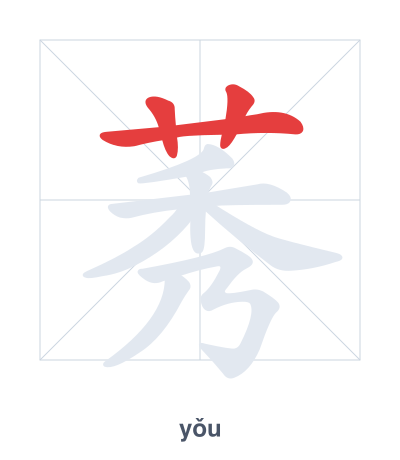
Open Hanzi Writer to see the animated stroke order and practice writing 莠 with real-time feedback.
The character 莠 (yǒu) is written with 10 strokes. Follow the standard Chinese stroke order: top to bottom, left to right, outside before inside. The radical 艹 is one of its key components.
Practice the correct stroke order with the Hanzi Writer app to see animated stroke-by-stroke guidance with real-time feedback.
莠 means weeds; green bristlegrass; evil.
莠 combines the grass radical 艹 with 秀 (ear of grain) to show a weed that resembles a grain crop, specifically green bristlegrass, which is harmful because it mimics the cultivated plant.
💡 Memory Tip: Picture a deceitful weed (艹) sprouting a fancy grain head (秀) to trick a farmer, but it's just an evil impostor.
这里的货品良莠不齐。
zhè lǐ de huò pǐn liáng yǒu bù qí
The quality of the goods here is uneven.
地里长了很多莠草。
dì lǐ zhǎng le hěn duō yǒu cǎo
Many weeds are growing in the field.
我们要及时除莠。
wǒ men yào jí shí chú yǒu
We should weed out the tares in time.
Open Hanzi Writer to see the animated stroke order and practice writing 莠 with real-time feedback.
✨ Animated stroke order · Handwriting recognition · HSK-graded practice · Free to use
The character 莠 combines the radical 艹 (grass) on top with 秀 (xiù, meaning elegant or beautiful) below. Together, they suggest a plant that looks elegant but is actually a harmful weed. This reflects the meaning "weeds" or "evil" – something that appears good but is bad.