楹 (yíng) means "pillar; column" in Chinese. It has 13 strokes with the radical 木.
Rated 4.2/5 in difficulty (advanced).
Appears in 3+ common words including 楹联 (yíng lián), 楹柱 (yíng zhù), 门楹 (mén yíng).
Due to its 13 strokes, Hanzi Writer's error detection shows 楹 requires focused practice — most learners need 10+ attempts for consistent accuracy.
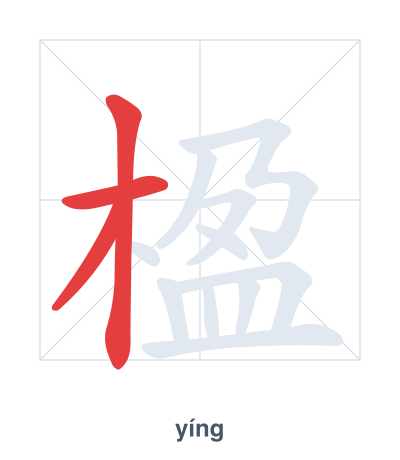
Open Hanzi Writer to see the animated stroke order and practice writing 楹 with real-time feedback.
The character 楹 (yíng) is written with 13 strokes. Follow the standard Chinese stroke order: top to bottom, left to right, outside before inside. The radical 木 is one of its key components.
Practice the correct stroke order with the Hanzi Writer app to see animated stroke-by-stroke guidance with real-time feedback.
楹 means pillar; column.
楹 is a compound character: the left radical 木 (wood) indicates the material, and the right component 盈 (yíng, meaning 'full' or 'abundant') provides the phonetic clue. Together, they evoke a sturdy wooden pillar that is full and supportive in architecture.
💡 Memory Tip: Picture a wooden pillar (木) so full (盈) of strength it holds up an entire temple porch.
门口贴着红色的楹联。
mén kǒu tiē zhe hóng sè de yíng lián
Red couplets are pasted on the doorway.
大殿的楹柱非常粗。
dà diàn de yíng zhù fēi cháng cū
The pillars of the main hall are very thick.
他在门楹上挂了灯笼。
tā zài mén yíng shàng guà le dēng lóng
He hung lanterns on the doorposts.
Open Hanzi Writer to see the animated stroke order and practice writing 楹 with real-time feedback.
✨ Animated stroke order · Handwriting recognition · HSK-graded practice · Free to use
The character 楹 is made of two parts: the left side is 木 (wood), which shows that the character relates to wood or wooden things, and the right side is 盈 (yíng, meaning full or abundant). Together, the character suggests a wooden pillar that supports a structure, as a pillar is often made of wood and needs to be full and strong.