莺 (yīng) means "Warbler / Oriole" in Chinese. It has 10 strokes with the radical 艹.
Rated 4.2/5 in difficulty (advanced).
Appears in 3+ common words including 黄莺 (huáng yīng), 莺歌 (yīng gē), 莺语 (yīng yǔ).
Due to its 10 strokes, Hanzi Writer's error detection shows 莺 requires focused practice — most learners need 10+ attempts for consistent accuracy.
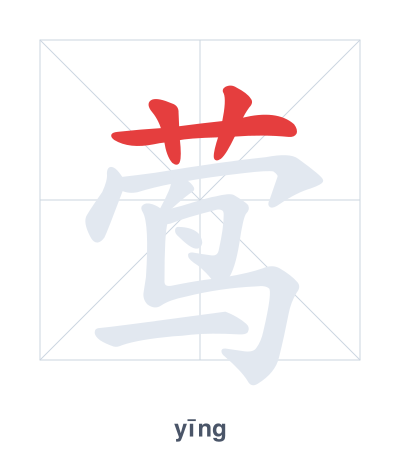
Open Hanzi Writer to see the animated stroke order and practice writing 莺 with real-time feedback.
The character 莺 (yīng) is written with 10 strokes. Follow the standard Chinese stroke order: top to bottom, left to right, outside before inside. The radical 艹 is one of its key components.
Practice the correct stroke order with the Hanzi Writer app to see animated stroke-by-stroke guidance with real-time feedback.
莺 means Warbler / Oriole.
莺 is a compound character with 鸟 (bird) and 艹 (grass), indicating a small songbird that inhabits grassy or reedy areas. The top includes 冖, which may represent a nest or canopy, evoking the bird's sheltered habitat.
💡 Memory Tip: Picture a warbler perched under a grassy thatch roof (艹+冖), chirping its song from the bird (鸟) shape below.
树上有黄莺在叫。
shù shàng yǒu huáng yīng zài jiào
An oriole is singing in the tree.
春天里莺歌燕舞。
chūn tiān lǐ yīng gē yàn wǔ
Orioles sing and swallows dance in spring.
莺语听起来动人。
yīng yǔ tīng qǐ lái dòng rén
The chirping of orioles sounds moving.
Open Hanzi Writer to see the animated stroke order and practice writing 莺 with real-time feedback.
✨ Animated stroke order · Handwriting recognition · HSK-graded practice · Free to use
莺 has a grass radical (艹) on top, which hints at its association with nature and birds in grassy or forest areas. Below is a phonetic component that provides the sound 'yīng', though the exact origin is debated. Together, the structure suggests a small bird that lives among plants.