Hanzi Writer

How to Write 樱 (yīng) — Meaning “cherry”

yīng 15 strokes Radical: 木

樱 (yīng) means "cherry" in Chinese. It has 15 strokes with the radical 木.

Rated 4.2/5 in difficulty (advanced).

Appears in 3+ common words including 樱花 (yīng huā), 樱桃 (yīng táo), 樱红 (yīng hóng).

Due to its 15 strokes, Hanzi Writer's error detection shows 樱 requires focused practice — most learners need 10+ attempts for consistent accuracy.
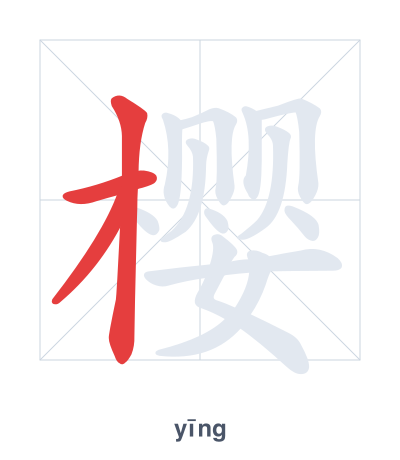
Stroke order practice for 樱 - yīng

Practice Writing 樱 (yīng)

Open Hanzi Writer to see the animated stroke order and practice writing 樱 with real-time feedback.

The character (yīng) is written with 15 strokes. Follow the standard Chinese stroke order: top to bottom, left to right, outside before inside. The radical is one of its key components.

Practice the correct stroke order with the Hanzi Writer app to see animated stroke-by-stroke guidance with real-time feedback.

means cherry.

Character
Pinyinyīng (ying)
Meaningcherry
Strokes15
Radical
Difficulty4.2/5

樱 is a phono-semantic compound character. The radical 木 (tree) indicates it's a type of tree, while the phonetic component 婴 (yīng, meaning 'baby') hints at the pronunciation. Together, they form 'cherry tree,' as cherry blossoms are often associated with the delicate, infant-like beauty of spring.

💡 Memory Tip: Imagine a cherry tree (木) with tiny, baby-like (婴) blossoms peeking out like a cluster of rosy cheeks.

yīng huā
cherry blossom
yīng táo
cherry
yīng hóng
cherry red

春天樱花开了。

chūn tiān yīng huā kāi le

Cherry blossoms bloom in spring.

我喜欢吃樱桃。

wǒ xǐ huān chī yīng táo

I like eating cherries.

她的脸蛋樱红。

tā de liǎn dàn yīng hóng

Her cheeks are cherry-red.

Character Pinyin Strokes Radical
(current) yīng 15
duàn 13
shèn 13
chuán 13
Stroke order practice for 樱 - yīng

Practice Writing 樱 (yīng)

Open Hanzi Writer to see the animated stroke order and practice writing 樱 with real-time feedback.

✨ Animated stroke order · Handwriting recognition · HSK-graded practice · Free to use

Frequently Asked Questions about 樱

樱 is made of two parts: the radical 木 (tree) on the left and 婴 (yīng, baby) on the right. The 木 indicates that the character relates to a tree, while 婴 provides the sound and hints at the small, round shape of cherry fruit, similar to a baby's face.

Characters with Radical 木

Other 15-Stroke Characters