佚 (yì) means "lost; missing (works)" in Chinese. It has 7 strokes with the radical 亻.
Rated 3.2/5 in difficulty (challenging).
Appears in 3+ common words including 佚名 (yì míng), 佚事 (yì shì), 散佚 (sàn yì).
Due to its 7 strokes, Hanzi Writer's error detection shows 佚 requires focused practice — most learners need 10+ attempts for consistent accuracy.
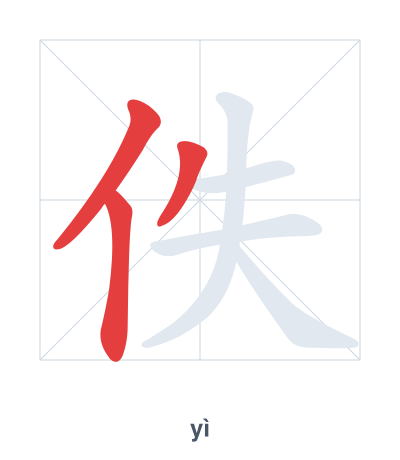
Open Hanzi Writer to see the animated stroke order and practice writing 佚 with real-time feedback.
The character 佚 (yì) is written with 7 strokes. Follow the standard Chinese stroke order: top to bottom, left to right, outside before inside. The radical 亻 is one of its key components.
Practice the correct stroke order with the Hanzi Writer app to see animated stroke-by-stroke guidance with real-time feedback.
佚 means lost; missing (works).
佚 combines the person radical 亻 with 失 (shī, 'to lose'), literally meaning 'a person who is lost' or 'something that has slipped away.' In ancient texts, it often refers to lost writings or missing works, as if they have wandered off and cannot be found.
💡 Memory Tip: Picture a person (亻) frantically searching for a missing key they just lost (失) — that's 佚, lost and missing.
这首诗的作者是佚名。
zhè shǒu shī de zuò zhě shì yì míng
The author of this poem is anonymous.
这是一个名人的佚事。
zhè shì yí gè míng rén de yì shì
This is an anecdote about a famous person.
很多古书已经散佚了。
hěn duō gǔ shū yǐ jīng sàn yì le
Many ancient books have been lost.
Open Hanzi Writer to see the animated stroke order and practice writing 佚 with real-time feedback.
✨ Animated stroke order · Handwriting recognition · HSK-graded practice · Free to use
佚 is made of the radical 亻 (person) on the left and 失 (lose) on the right. Together they suggest a person who has lost something, which gives the meaning 'lost' or 'missing', especially for written works.