Hanzi Writer

How to Write 矬 (cuó) — Meaning “Short (in stature); stunted.”

cuó 12 strokes Radical: 矢

矬 (cuó) means "Short (in stature); stunted." in Chinese. It has 12 strokes with the radical 矢.

Rated 4.2/5 in difficulty (advanced).

Appears in 3+ common words including 矬子 (cuó zi), 矮矬 (ǎi cuó), 矬矮 (cuó ǎi).

Due to its 12 strokes, Hanzi Writer's error detection shows 矬 requires focused practice — most learners need 10+ attempts for consistent accuracy.
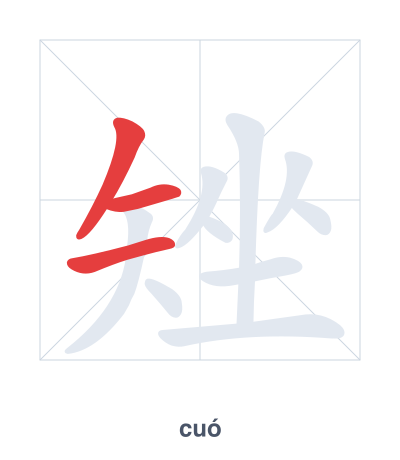
Stroke order practice for 矬 - cuó

Practice Writing 矬 (cuó)

Open Hanzi Writer to see the animated stroke order and practice writing 矬 with real-time feedback.

The character (cuó) is written with 12 strokes. Follow the standard Chinese stroke order: top to bottom, left to right, outside before inside. The radical is one of its key components.

Practice the correct stroke order with the Hanzi Writer app to see animated stroke-by-stroke guidance with real-time feedback.

means Short (in stature); stunted..

Character
Pinyincuó (cuo)
MeaningShort (in stature); stunted.
Strokes12
Radical
Difficulty4.2/5

矬 combines the radical 矢 (arrow, also used in characters related to length or measure) with the phonetic component 坐 (to sit). The arrow suggests measurement of height, while sitting implies being low to the ground, together indicating a short or stunted stature.

💡 Memory Tip: Picture an arrow (矢) that becomes squashed and short because two people (from 坐) are sitting on top of it, stunting its length.

cuó zi
A short person (often derogatory).
ǎi cuó
Short and squat.
cuó ǎi
Short and small.

他个子像个矬子。

tā gè zi xiàng gè cuó zi

He is as short as a dwarf.

这个凳子很矮矬。

zhè ge dèng zi hěn ǎi cuó

This stool is very short and squat.

树长得很矬矮。

shù zhǎng dé hěn cuó ǎi

The tree is very short and stunted.

Character Pinyin Strokes Radical
(current) cuó 12
jiǎo 11
duǎn 12
ǎi 13
Stroke order practice for 矬 - cuó

Practice Writing 矬 (cuó)

Open Hanzi Writer to see the animated stroke order and practice writing 矬 with real-time feedback.

✨ Animated stroke order · Handwriting recognition · HSK-graded practice · Free to use

Frequently Asked Questions about 矬

矬 is formed with the radical 矢 (arrow) on the left and the phonetic component 坐 (to sit) on the right. The radical 矢 is used in characters related to measure or height, like 短 (short) and 矫 (correct). Together, they suggest a person who is short enough to sit down — reinforcing the idea of being short in stature.

Characters with Radical 矢

Other 12-Stroke Characters