晔 (yè) means "bright; resplendent" in Chinese. It has 10 strokes with the radical 日.
Rated 4.2/5 in difficulty (advanced).
Appears in 3+ common words including 晔晔 (yè yè), 晔然 (yè rán), 荣晔 (róng yè).
Due to its 10 strokes, Hanzi Writer's error detection shows 晔 requires focused practice — most learners need 10+ attempts for consistent accuracy.
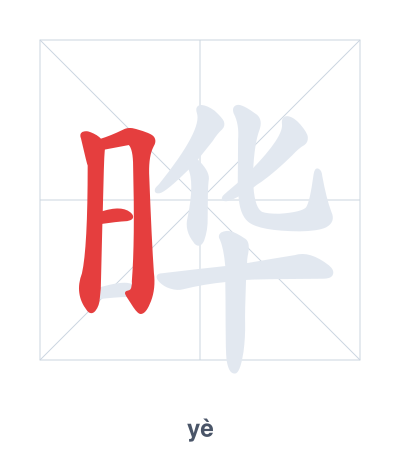
Open Hanzi Writer to see the animated stroke order and practice writing 晔 with real-time feedback.
The character 晔 (yè) is written with 10 strokes. Follow the standard Chinese stroke order: top to bottom, left to right, outside before inside. The radical 日 is one of its key components.
Practice the correct stroke order with the Hanzi Writer app to see animated stroke-by-stroke guidance with real-time feedback.
晔 means bright; resplendent.
晔 combines 日 (sun, the radical) with 华 (華, meaning 'splendor' or 'flower'), where 华 provides both the sound (yè via historical connection) and the idea of brilliance or flourishing beauty. Together, the sun's radiance meeting splendor creates the sense of dazzling brightness.
💡 Memory Tip: Picture the sun (日) shining on a magnificent flower (华), making its petals glow with resplendent light.
灯光晔晔。
dēng guāng yè yè
The lights are shining brightly.
文采晔然。
wén cǎi yè rán
The literary style is brilliant and radiant.
花朵很荣晔。
huā duǒ hěn róng yè
The flowers are bright and flourishing.
Open Hanzi Writer to see the animated stroke order and practice writing 晔 with real-time feedback.
✨ Animated stroke order · Handwriting recognition · HSK-graded practice · Free to use
晔 is composed of the radical 日 (sun) on the left, and 华 (yè/huá, meaning 'splendid' or 'flower') on the right. The sun radical suggests brightness, while 华 contributes the idea of brilliance or glory, together forming the meaning 'bright' or 'resplendent'.