湮 (yān) means "To submerge or fall into oblivion." in Chinese. It has 12 strokes with the radical 氵.
Rated 4.2/5 in difficulty (advanced).
Appears in 3+ common words including 湮没 (yān mò), 湮灭 (yān miè), 湮郁 (yān yù).
Due to its 12 strokes, Hanzi Writer's error detection shows 湮 requires focused practice — most learners need 10+ attempts for consistent accuracy.
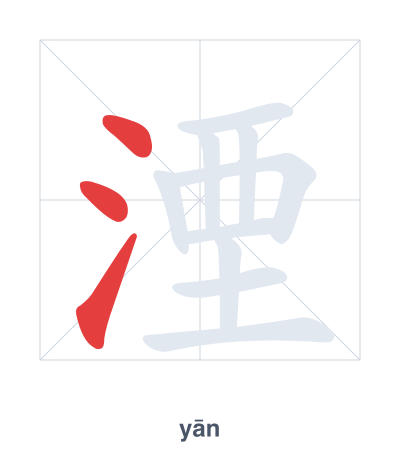
Open Hanzi Writer to see the animated stroke order and practice writing 湮 with real-time feedback.
The character 湮 (yān) is written with 12 strokes. Follow the standard Chinese stroke order: top to bottom, left to right, outside before inside. The radical 氵 is one of its key components.
Practice the correct stroke order with the Hanzi Writer app to see animated stroke-by-stroke guidance with real-time feedback.
湮 means To submerge or fall into oblivion..
湮 combines the water radical 氵 with 垔 (yīn), a component that originally depicted a blocked or obstructed channel. Together, they convey the idea of water being held back or covering something, leading to the meanings 'to submerge' or 'to fall into oblivion.'
💡 Memory Tip: Imagine a wave (氵) covering an ancient tomb (垔, resembling a sealed burial mound) so that it sinks into oblivion.
历史被湮没了。
lì shǐ bèi yān mò le
History has been obscured or buried.
证据已经湮灭。
zhèng jù yǐ jīng yān miè
The evidence has been destroyed.
他心情很湮郁。
tā xīn qíng hěn yān yù
He felt very gloomy and depressed.
Open Hanzi Writer to see the animated stroke order and practice writing 湮 with real-time feedback.
✨ Animated stroke order · Handwriting recognition · HSK-graded practice · Free to use
湮 is composed of the water radical 氵 on the left and the phonetic component 垔 (yīn) on the right. The water radical suggests submerging or flooding, while 垔 originally meant to block or dam, together conveying the idea of water covering something until it is lost. This combination gives the overall meaning of being submerged or falling into oblivion.