鲟 (xún) means "Sturgeon" in Chinese. It has 14 strokes with the radical 鱼.
Rated 4.2/5 in difficulty (advanced).
Appears in 3+ common words including 鲟鱼 (xún yú), 中华鲟 (zhōng huá xún), 鲟鱼子 (xún yú zi).
Due to its 14 strokes, Hanzi Writer's error detection shows 鲟 requires focused practice — most learners need 10+ attempts for consistent accuracy.
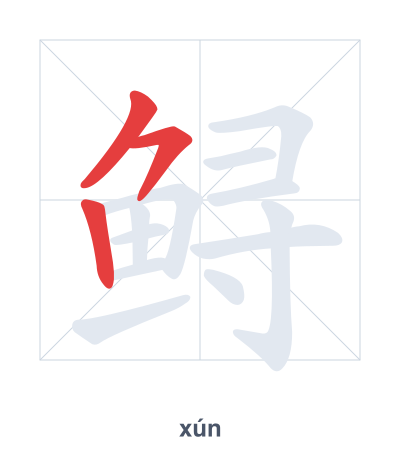
Open Hanzi Writer to see the animated stroke order and practice writing 鲟 with real-time feedback.
The character 鲟 (xún) is written with 14 strokes. Follow the standard Chinese stroke order: top to bottom, left to right, outside before inside. The radical 鱼 is one of its key components.
Practice the correct stroke order with the Hanzi Writer app to see animated stroke-by-stroke guidance with real-time feedback.
鲟 means Sturgeon.
鲟 is a semantic-phonetic compound. The left radical 鱼 (fish) indicates it belongs to the fish family. The right component 寻 (xún, meaning 'to search' or 'seek') provides the pronunciation and hints at the sturgeon's feeding behavior of searching along riverbeds for food.
💡 Memory Tip: Picture a sturgeon (鱼) using its long snout to search (寻) the muddy river bottom for tasty morsels.
鲟鱼的个头很大。
xún yú de gè tóu hěn dà
Sturgeons are very large.
中华鲟很珍贵。
zhōng huá xún hěn zhēn guì
The Chinese sturgeon is very precious.
鲟鱼子很贵。
xún yú zi hěn guì
Caviar is very expensive.
Open Hanzi Writer to see the animated stroke order and practice writing 鲟 with real-time feedback.
✨ Animated stroke order · Handwriting recognition · HSK-graded practice · Free to use
鲟 is composed of the radical 鱼 (fish) on the left, showing it is a type of fish, and the phonetic component 寻 (xún) on the right, which gives the pronunciation. So the character means "sturgeon" — a fish named after the sound xún.