荨 (xún) means "nettle" in Chinese. It has 9 strokes with the radical 艹.
Rated 4/5 in difficulty (challenging).
Appears in 2+ common words including 荨麻疹 (xún má zhěn), 荨麻 (xún má).
Due to its 9 strokes, Hanzi Writer's error detection shows 荨 requires focused practice — most learners need 10+ attempts for consistent accuracy.
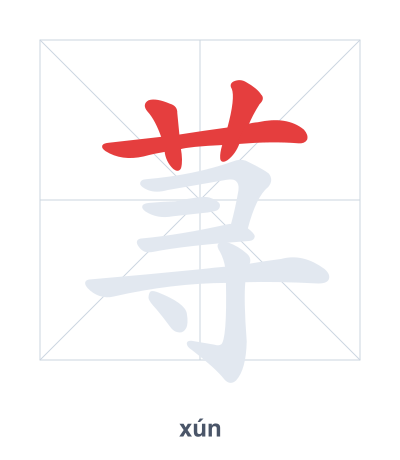
Open Hanzi Writer to see the animated stroke order and practice writing 荨 with real-time feedback.
The character 荨 (xún) is written with 9 strokes. Follow the standard Chinese stroke order: top to bottom, left to right, outside before inside. The radical 艹 is one of its key components.
Practice the correct stroke order with the Hanzi Writer app to see animated stroke-by-stroke guidance with real-time feedback.
荨 means nettle.
This character is a phono-semantic compound: the radical 艹 (grass) indicates it is a plant, while 寻 (xún) provides the pronunciation. Nettles are stinging plants commonly found in grassy areas, linking the visual components to the meaning.
💡 Memory Tip: Imagine searching (寻) through grass (艹) and getting stung by a hidden nettle.
接触了过敏原后,他身上起了很多荨麻疹。
jiē chù le guò mǐn yuán hòu tā shēn shàng qǐ le hěn duō xún má zhěn
After coming into contact with allergens, he broke out in hives.
这种野生的荨麻叶子边缘长满了细小的刺。
zhè zhǒng yě shēng de xún má yè zi biān yuán zhǎng mǎn le xì xiǎo de cì
The edges of these wild nettle leaves are covered with tiny thorns.
Open Hanzi Writer to see the animated stroke order and practice writing 荨 with real-time feedback.
✨ Animated stroke order · Handwriting recognition · HSK-graded practice · Free to use
The character is made of two parts: the radical 艹 (grass) on top and the phonetic component 寻 (xún, meaning 'to search') below. The grass radical indicates it is a plant, and the phonetic part gives the pronunciation. Together, they form the word for nettle, a type of plant.