荀 (xún) means "Xun (a Chinese surname)" in Chinese. It has 9 strokes with the radical 艹.
Rated 4/5 in difficulty (challenging).
Appears in 3+ common words including 荀子 (xún zi), 姓荀 (xìng xún), 荀彧 (xún yù).
Due to its 9 strokes, Hanzi Writer's error detection shows 荀 requires focused practice — most learners need 10+ attempts for consistent accuracy.
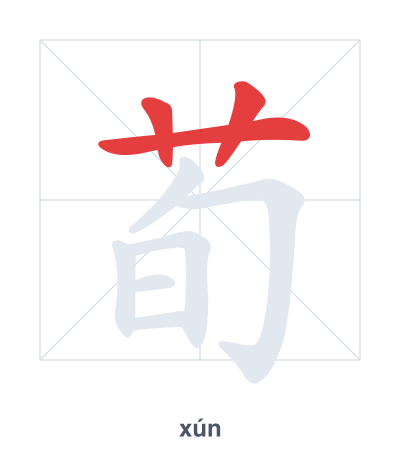
Open Hanzi Writer to see the animated stroke order and practice writing 荀 with real-time feedback.
The character 荀 (xún) is written with 9 strokes. Follow the standard Chinese stroke order: top to bottom, left to right, outside before inside. The radical 艹 is one of its key components.
Practice the correct stroke order with the Hanzi Writer app to see animated stroke-by-stroke guidance with real-time feedback.
荀 means Xun (a Chinese surname).
荀 combines the grass radical (艹) with 旬 (xún, 'ten-day period') as a phonetic component. It originally referred to a type of plant, but later became the surname of the ancient philosopher Xunzi. The grass radical hints at vegetation, while 旬 provides the sound.
💡 Memory Tip: Picture a patch of grass (艹) that grows exactly ten days (旬) later—perfect for remembering the Xun surname from the philosopher who taught that human nature is evil.
荀子是著名的思想家。
xún zi shì zhù míng de sī xiǎng jiā
Xunzi was a famous philosopher.
我的老师姓荀。
wǒ de lǎo shī xìng xún
My teacher's surname is Xun.
荀彧是三国时期的人。
xún yù shì sān guó shí qī de rén
Xun Yu was a person from the Three Kingdoms period.
Open Hanzi Writer to see the animated stroke order and practice writing 荀 with real-time feedback.
✨ Animated stroke order · Handwriting recognition · HSK-graded practice · Free to use
荀 combines the grass radical 艹 on top with 旬 (xún) below. Since 荀 is primarily a surname, the grass radical may hint at ancient connections to plants or regions, while 旬 provides the sound.