硎 (xíng) means "Whetstone" in Chinese. It has 11 strokes with the radical 石.
Rated 4.2/5 in difficulty (advanced).
Appears in 3+ common words including 硎谷 (xíng gǔ), 磨硎 (mó xíng), 硎石 (xíng shí).
Due to its 11 strokes, Hanzi Writer's error detection shows 硎 requires focused practice — most learners need 10+ attempts for consistent accuracy.
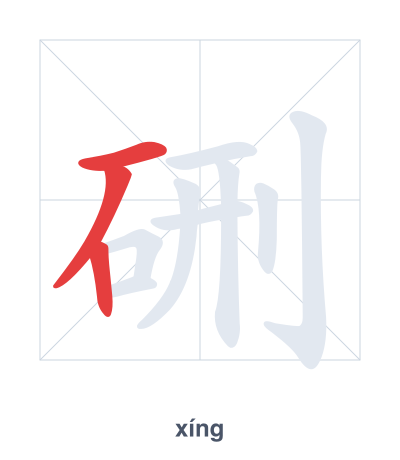
Open Hanzi Writer to see the animated stroke order and practice writing 硎 with real-time feedback.
The character 硎 (xíng) is written with 11 strokes. Follow the standard Chinese stroke order: top to bottom, left to right, outside before inside. The radical 石 is one of its key components.
Practice the correct stroke order with the Hanzi Writer app to see animated stroke-by-stroke guidance with real-time feedback.
硎 means Whetstone.
硎 combines the radical 石 (stone) with 刑 (xíng, meaning 'punishment' or 'to cut'), which also provides the pronunciation. The idea is a stone used for cutting or sharpening blades, linking the punishing action of cutting to the whetstone's purpose.
💡 Memory Tip: Picture a stone (石) that 'punishes' (刑) a dull knife by scraping it into sharpness.
硎谷的风景很美。
xíng gǔ de fēng jǐng hěn měi
The scenery of Xing Valley is very beautiful.
宝剑需要磨硎。
bǎo jiàn xū yào mó xíng
The sword needs to be sharpened on a whetstone.
这是一块硎石。
zhè shì yī kuài xíng shí
This is a grindstone.
Open Hanzi Writer to see the animated stroke order and practice writing 硎 with real-time feedback.
✨ Animated stroke order · Handwriting recognition · HSK-graded practice · Free to use
硎 is a left-right character. The left radical 石 (shí, stone) indicates that the word relates to stone. The right part 刑 (xíng) gives the pronunciation and originally relates to cutting or sharpening, so together they mean a whetstone used for sharpening blades.