屭 (xì) means "gigantic strength (mythological)" in Chinese. It has 24 strokes with the radical 尸.
Rated 3.8/5 in difficulty (challenging).
Appears in 3+ common words including 赑屭 (bì xì), 屭负 (xì fù), 屭屭 (xì xì).
Due to its 24 strokes, Hanzi Writer's error detection shows 屭 requires focused practice — most learners need 10+ attempts for consistent accuracy.
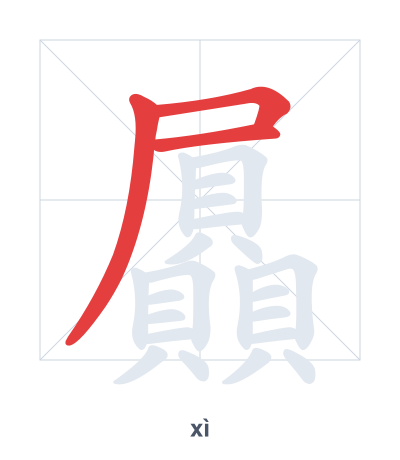
Open Hanzi Writer to see the animated stroke order and practice writing 屭 with real-time feedback.
The character 屭 (xì) is written with 24 strokes. Follow the standard Chinese stroke order: top to bottom, left to right, outside before inside. The radical 尸 is one of its key components.
Practice the correct stroke order with the Hanzi Writer app to see animated stroke-by-stroke guidance with real-time feedback.
屭 means gigantic strength (mythological).
屭 combines 尸 (corpse, but here representing a creature's body) and 賁 (meaning 'great' or 'vigorous'), forming a picture of a massive, powerful mythological beast known for its immense strength.
💡 Memory Tip: Imagine a giant tortoise-like monster (尸) with bulging muscles (賁) lifting a stone tablet so heavy it cracks the ground beneath.
碑下有赑屭。
bēi xià yǒu bì xì
There is a Bixi (mythical tortoise) under the stele.
巨兽屭负重物。
jù shòu xì fù zhòng wù
The giant beast Bixi carries a heavy load.
样子很屭屭。
yàng zi hěn xì xì
The appearance looks very heavy and strained.
Open Hanzi Writer to see the animated stroke order and practice writing 屭 with real-time feedback.
✨ Animated stroke order · Handwriting recognition · HSK-graded practice · Free to use
屭 has the radical 尸 (corpse) on the left and a complex right side that includes 畐 (fú, meaning 'full') and 贝 (bèi, meaning 'shell/money'). The combination suggests a creature with a heavy shell, linking to the mythological turtle-like being 赑屭 that carries enormous weight.