矗 (chù) means "to stand tall; upright" in Chinese. It has 24 strokes with the radical 目.
Rated 3.5/5 in difficulty (challenging).
Appears in 3+ common words including 矗立 (chù lì), 矗起 (chù qǐ), 矗矗 (chù chù).
Due to its 24 strokes, Hanzi Writer's error detection shows 矗 requires focused practice — most learners need 10+ attempts for consistent accuracy.
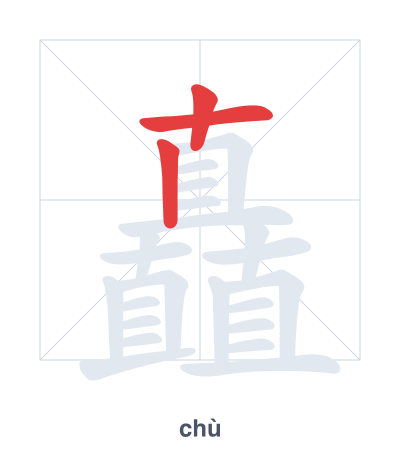
Open Hanzi Writer to see the animated stroke order and practice writing 矗 with real-time feedback.
The character 矗 (chù) is written with 24 strokes. Follow the standard Chinese stroke order: top to bottom, left to right, outside before inside. The radical 目 is one of its key components.
Practice the correct stroke order with the Hanzi Writer app to see animated stroke-by-stroke guidance with real-time feedback.
矗 means to stand tall; upright.
The character 矗 is formed by stacking three instances of 直 (zhí, meaning 'upright' or 'straight'), each containing a 目 (eye) component that originally depicted a line of sight. This triple repetition visually emphasizes extreme verticality and stability, conveying the meaning of towering upward or standing tall and upright, like a cluster of peaks or pillars.
💡 Memory Tip: Picture three straight towers (直,直,直) piled on top of each other, reaching so high into the sky that they 矗 (stand tall) above everything else.
高塔矗立在山顶。
gāo tǎ chù lì zài shān dǐng
The high tower stands tall on the mountain top.
烟囱高高矗起。
yān cōng gāo gāo chù qǐ
The chimney towers high.
远处的山峰矗矗。
yuǎn chù de shān fēng chù chù
The distant peaks stood tall.
Open Hanzi Writer to see the animated stroke order and practice writing 矗 with real-time feedback.
✨ Animated stroke order · Handwriting recognition · HSK-graded practice · Free to use
矗 is made of three 直 (zhí) characters stacked vertically. Each 直 means 'straight' or 'upright', so three of them together emphasize the idea of standing tall and firmly upright. The radical 目 (eye) appears in each 直 but is not the main meaning driver here.