灞 (bà) means "Ba River (in Shaanxi)" in Chinese. It has 24 strokes with the radical 氵.
Rated 3.8/5 in difficulty (challenging).
Appears in 3+ common words including 灞河 (bà hé), 灞桥 (bà qiáo), 灞柳 (bà liǔ).
Due to its 24 strokes, Hanzi Writer's error detection shows 灞 requires focused practice — most learners need 10+ attempts for consistent accuracy.
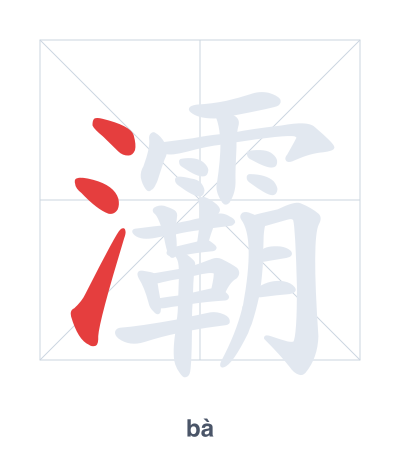
Open Hanzi Writer to see the animated stroke order and practice writing 灞 with real-time feedback.
The character 灞 (bà) is written with 24 strokes. Follow the standard Chinese stroke order: top to bottom, left to right, outside before inside. The radical 氵 is one of its key components.
Practice the correct stroke order with the Hanzi Writer app to see animated stroke-by-stroke guidance with real-time feedback.
灞 means Ba River (in Shaanxi).
灞 is a phono-semantic compound where the water radical 氵 (meaning river) combines with 霸 (bà, meaning overlord or tyrant) to provide the pronunciation and a hint of the river's forceful nature. The Ba River in Shaanxi was historically significant, often associated with the powerful Qin dynasty, hence the 'tyrant' component.
💡 Memory Tip: Imagine the Ba River's water (氵) raging like a tyrant (霸) as it floods the land, overwhelming everything in its path.
西安有一条灞河。
xī ān yǒu yī tiáo bà hé
There is a Ba River in Xi'an.
灞桥就在河上面。
bà qiáo jiù zài hé shàng miàn
Ba Bridge is right over the river.
灞柳在风中摇摆。
bà liǔ zài fēng zhōng yáo bǎi
The Ba River willows are swaying in the wind.
Open Hanzi Writer to see the animated stroke order and practice writing 灞 with real-time feedback.
✨ Animated stroke order · Handwriting recognition · HSK-graded practice · Free to use
灞 is composed of the water radical 氵 on the left and a complex right side 霸 (bà, meaning 'overlord' or 'tyrant'). The water radical indicates the character relates to a river, and together they form the name of the Ba River in Shaanxi. The right side 霸 provides the pronunciation bà.