蠹 (dù) means "Bookworm / Wood-boring insect" in Chinese. It has 24 strokes with the radical 虫.
Rated 4.2/5 in difficulty (advanced).
Appears in 3+ common words including 蠹虫 (dù chóng), 蠹害 (dù hài), 蠹蚀 (dù shí).
Due to its 24 strokes, Hanzi Writer's error detection shows 蠹 requires focused practice — most learners need 10+ attempts for consistent accuracy.
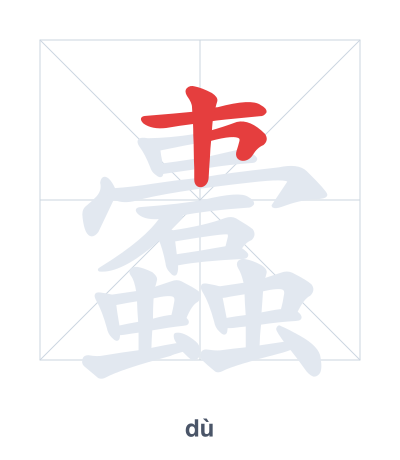
Open Hanzi Writer to see the animated stroke order and practice writing 蠹 with real-time feedback.
The character 蠹 (dù) is written with 24 strokes. Follow the standard Chinese stroke order: top to bottom, left to right, outside before inside. The radical 虫 is one of its key components.
Practice the correct stroke order with the Hanzi Writer app to see animated stroke-by-stroke guidance with real-time feedback.
蠹 means Bookworm / Wood-boring insect.
蠹 is a phono-semantic compound: the radical 虫 (insect) indicates a bug, while the top part 槖 (tuó) originally depicted a leather bag or bellows, here providing pronunciation. The character literally means 'an insect that bores into wood or books,' with the 木 (wood) component inside 槖 reinforcing the idea of wood-eating. The 24 strokes create a dense, worm-like visual that echoes the insect's destructive tunneling.
💡 Memory Tip: Imagine a fat bookworm (虫) squeezing into a wooden bookcase (槖 looks like a bag stuffed with wood and stone), chewing through pages until the whole thing collapses into a dusty heap.
书里有蠹虫。
shū lǐ yǒu dù chóng
There are bookworms in the book.
蠹害非常严重。
dù hài fēi cháng yán zhòng
The insect damage is very serious.
木头被蠹蚀了。
mù tou bèi dù shí le
The wood has been eaten away by woodworms.
Open Hanzi Writer to see the animated stroke order and practice writing 蠹 with real-time feedback.
✨ Animated stroke order · Handwriting recognition · HSK-graded practice · Free to use
蠹 is made of three parts: stone (石), wood (木), and insect (虫). The insect (虫) is shown eating through both wood and stone, representing a destructive pest. This directly relates to its meaning as a wood-boring insect or bookworm.