寤 (wù) means "To wake up; awake." in Chinese. It has 14 strokes with the radical 宀.
Rated 4.2/5 in difficulty (advanced).
Appears in 3+ common words including 寤寐 (wù mèi), 寤生 (wù shēng), 寤思 (wù sī).
Due to its 14 strokes, Hanzi Writer's error detection shows 寤 requires focused practice — most learners need 10+ attempts for consistent accuracy.
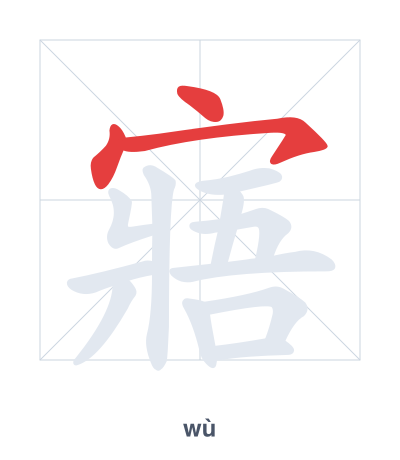
Open Hanzi Writer to see the animated stroke order and practice writing 寤 with real-time feedback.
The character 寤 (wù) is written with 14 strokes. Follow the standard Chinese stroke order: top to bottom, left to right, outside before inside. The radical 宀 is one of its key components.
Practice the correct stroke order with the Hanzi Writer app to see animated stroke-by-stroke guidance with real-time feedback.
寤 means To wake up; awake..
寤 is a compound character with the radical 宀 (roof, indicating a house where one sleeps) and a phonetic component derived from 吾 (wú). Its original form in Shuowen related to waking from a dream, combining the sleeping place with the sound 'wù'.
💡 Memory Tip: Imagine waking under a roof (宀) as a net (罒) of dreams is hooked away (乚) — you are now alert.
他寤寐求之。
tā wù mèi qiú zhī
He sought it day and night.
这是一个寤生子。
zhè shì yí gè wù shēng zi
This is a breech-born child.
他半夜寤思。
tā bàn yè wù sī
He lay awake thinking in the middle of the night.
Open Hanzi Writer to see the animated stroke order and practice writing 寤 with real-time feedback.
✨ Animated stroke order · Handwriting recognition · HSK-graded practice · Free to use
寤 is composed of 宀 (roof, suggesting a house or bed) on top, and 吾 (wú, meaning 'I' or 'my') below. The roof radical implies the context of sleeping or a bedroom, while 吾 represents the self who wakes up. This combination creates the idea of 'myself waking under the roof.'