寐 (mèi) means "to sleep" in Chinese. It has 12 strokes with the radical 宀.
Rated 4.2/5 in difficulty (advanced).
Appears in 3+ common words including 梦寐以求 (mèng mèi yǐ qiú), 假寐 (jiǎ mèi), 梦寐 (mèng mèi).
Due to its 12 strokes, Hanzi Writer's error detection shows 寐 requires focused practice — most learners need 10+ attempts for consistent accuracy.
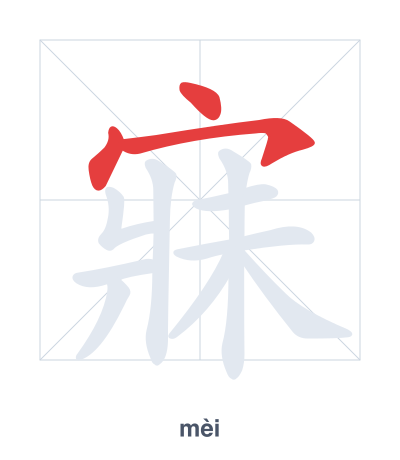
Open Hanzi Writer to see the animated stroke order and practice writing 寐 with real-time feedback.
The character 寐 (mèi) is written with 12 strokes. Follow the standard Chinese stroke order: top to bottom, left to right, outside before inside. The radical 宀 is one of its key components.
Practice the correct stroke order with the Hanzi Writer app to see animated stroke-by-stroke guidance with real-time feedback.
寐 means to sleep.
寐 is a phono-semantic compound where the radical 宀 (roof) provides the meaning of shelter or place to sleep, and the component 未 (wèi, 'not yet') serves as a phonetic hint. The original meaning is 'to fall asleep' or 'to be asleep,' with the roof indicating a sleeping environment.
💡 Memory Tip: Under the roof (宀), it is not yet (未) morning, so you are still asleep.
这是他梦寐以求的机会。
zhè shì tā mèng mèi yǐ qiú de jī huì
This is the opportunity he has always dreamed of.
他在沙发上闭目假寐。
tā zài shā fā shàng bì mù jiǎ mèi
He is dozing on the sofa with his eyes closed.
他在梦寐中呼唤名字。
tā zài mèng mèi zhōng hū huàn míng zì
He called out the name in his sleep.
Open Hanzi Writer to see the animated stroke order and practice writing 寐 with real-time feedback.
✨ Animated stroke order · Handwriting recognition · HSK-graded practice · Free to use
寐 has the radical 宀 (roof) on top, which suggests a house or a place for sleeping. The lower part is 未 (wèi, meaning 'not yet'), hinting that a person under a roof has not yet woken up. Together, the character conveys the idea of being asleep under a roof.