洧 (wěi) means "Wei (name of a river)" in Chinese. It has 9 strokes with the radical 氵.
Rated 4/5 in difficulty (challenging).
Appears in 3+ common words including 洧河 (wěi hé), 洧川 (wěi chuān), 洧水 (wěi shuǐ).
Due to its 9 strokes, Hanzi Writer's error detection shows 洧 requires focused practice — most learners need 10+ attempts for consistent accuracy.
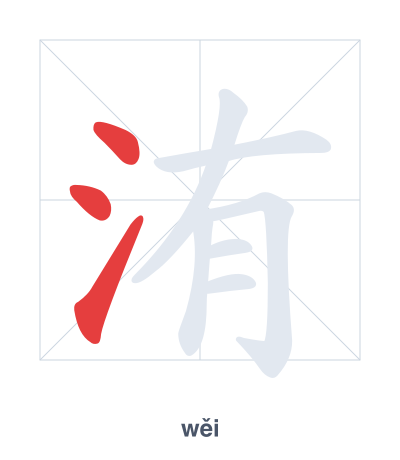
Open Hanzi Writer to see the animated stroke order and practice writing 洧 with real-time feedback.
The character 洧 (wěi) is written with 9 strokes. Follow the standard Chinese stroke order: top to bottom, left to right, outside before inside. The radical 氵 is one of its key components.
Practice the correct stroke order with the Hanzi Writer app to see animated stroke-by-stroke guidance with real-time feedback.
洧 means Wei (name of a river).
洧 is a phono-semantic compound. The left radical 氵 (water) indicates the character relates to a river or water, while the right component 有 (yǒu) provides the pronunciation wěi and also suggests the sense of 'having' or 'existing.' Together, they form the name of a specific river in ancient China.
💡 Memory Tip: Picture a hand (有) holding a moon beside a river (氵), showing that the Wei River has a beautiful moonlit reflection.
洧河的水非常清澈。
wěi hé de shuǐ fēi cháng qīng chè
The water of the Wei River is very clear.
他出生在洧川这个地方。
tā chū shēng zài wěi chuān zhè ge dì fāng
He was born in a place called Weichuan.
洧水向东方流去。
wěi shuǐ xiàng dōng fāng liú qù
The Wei River flows to the east.
Open Hanzi Writer to see the animated stroke order and practice writing 洧 with real-time feedback.
✨ Animated stroke order · Handwriting recognition · HSK-graded practice · Free to use
洧 is made of the water radical 氵 on the left and the character 有 on the right. The water radical indicates that the character relates to a river or water, while 有 is a phonetic component that gives the sound wěi and does not carry its usual meaning of 'to have'.