莛 (tíng) means "stalk (of grass or grain)" in Chinese. It has 9 strokes with the radical 艹.
Rated 4/5 in difficulty (challenging).
Appears in 3+ common words including 麦莛 (mài tíng), 莛子 (tíng zi), 抽莛 (chōu tíng).
Due to its 9 strokes, Hanzi Writer's error detection shows 莛 requires focused practice — most learners need 10+ attempts for consistent accuracy.
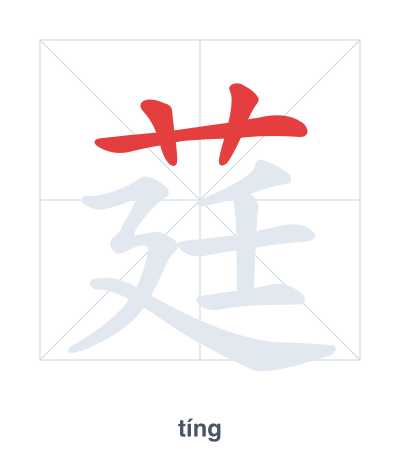
Open Hanzi Writer to see the animated stroke order and practice writing 莛 with real-time feedback.
The character 莛 (tíng) is written with 9 strokes. Follow the standard Chinese stroke order: top to bottom, left to right, outside before inside. The radical 艹 is one of its key components.
Practice the correct stroke order with the Hanzi Writer app to see animated stroke-by-stroke guidance with real-time feedback.
莛 means stalk (of grass or grain).
莛 is a compound character formed from the radical 艹 (grass) and the phonetic component 廷 (tíng, meaning 'court' or 'palace'). The grass radical suggests that the character relates to plants, while the phonetic 廷 gives the pronunciation; together, they depict a grass stalk standing tall and straight like a palace pillar.
💡 Memory Tip: Picture a grass stalk (艹) standing tall and straight in the middle of a royal court (廷), like a tiny pillar.
麦莛可以编成草帽。
mài tíng kě yǐ biān chéng cǎo mào
Wheat stalks can be woven into straw hats.
这个植物的莛子很硬。
zhè ge zhí wù de tíng zi hěn yìng
The stalk of this plant is very hard.
地里的庄稼开始抽莛了。
dì lǐ de zhuāng jià kāi shǐ chōu tíng le
The crops in the field are starting to bolt.
Open Hanzi Writer to see the animated stroke order and practice writing 莛 with real-time feedback.
✨ Animated stroke order · Handwriting recognition · HSK-graded practice · Free to use
莛 is composed of the radical 艹 (grass) on top and the phonetic component 廷 (tíng) below. The grass radical indicates the character relates to plants, and 廷 provides the pronunciation. Together they create the meaning "stalk" or "stem" of a grass or grain plant.