鳀 (tí) means "Anchovy" in Chinese. It has 17 strokes with the radical 鱼.
Rated 4.2/5 in difficulty (advanced).
Appears in 3+ common words including 鳀鱼 (tí yú), 鳀鱼酱 (tí yú jiàng), 鳀类 (tí lèi).
Due to its 17 strokes, Hanzi Writer's error detection shows 鳀 requires focused practice — most learners need 10+ attempts for consistent accuracy.
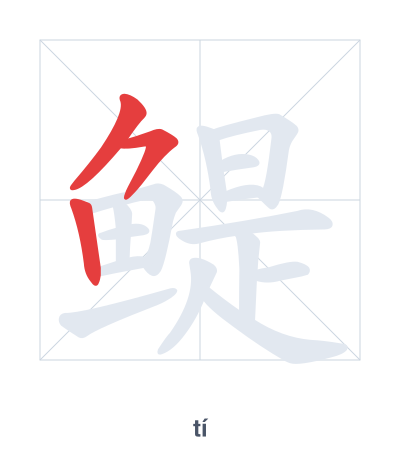
Open Hanzi Writer to see the animated stroke order and practice writing 鳀 with real-time feedback.
The character 鳀 (tí) is written with 17 strokes. Follow the standard Chinese stroke order: top to bottom, left to right, outside before inside. The radical 鱼 is one of its key components.
Practice the correct stroke order with the Hanzi Writer app to see animated stroke-by-stroke guidance with real-time feedback.
鳀 means Anchovy.
This phono-semantic compound combines the radical 鱼 (fish) with 是 (shì) as a phonetic component. The radical indicates it is a type of fish, while 是 hints at the pronunciation tí (though its usual reading is shì, reflecting an ancient sound shift). Anchovy is a small, silvery fish fitting this fish radical.
💡 Memory Tip: Picture a tiny fish (鱼) that is (是) so small you can only say 'tee-hee' (tí) — it's an anchovy.
鳀鱼可以做罐头。
tí yú kě yǐ zuò guàn tou
Anchovies can be canned.
鳀鱼酱很有名。
tí yú jiàng hěn yǒu míng
Anchovy sauce is very famous.
鳀类是很小的鱼。
tí lèi shì hěn xiǎo de yú
Anchovies are very small fish.
Open Hanzi Writer to see the animated stroke order and practice writing 鳀 with real-time feedback.
✨ Animated stroke order · Handwriting recognition · HSK-graded practice · Free to use
The left radical 鱼 (yú) means 'fish,' which tells you 鳀 is a type of fish. The right part 是 (shì) means 'to be' but does not contribute to the meaning—it mainly helps distinguish the character visually. Together, 鳀 refers to the anchovy.