荑 (tí) means "Young sprout of cogon grass" in Chinese. It has 9 strokes with the radical 艹.
Rated 4/5 in difficulty (challenging).
Appears in 3+ common words including 手如柔荑 (shǒu rú róu tí), 荑草 (tí cǎo), 柔荑 (róu tí).
Due to its 9 strokes, Hanzi Writer's error detection shows 荑 requires focused practice — most learners need 10+ attempts for consistent accuracy.
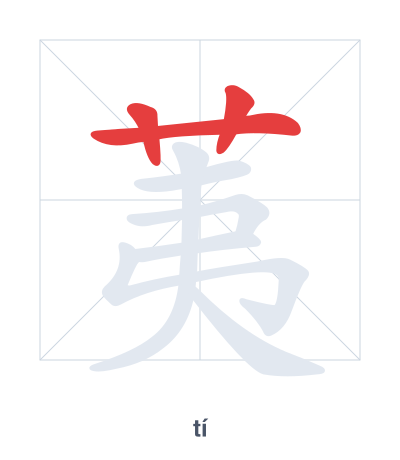
Open Hanzi Writer to see the animated stroke order and practice writing 荑 with real-time feedback.
The character 荑 (tí) is written with 9 strokes. Follow the standard Chinese stroke order: top to bottom, left to right, outside before inside. The radical 艹 is one of its key components.
Practice the correct stroke order with the Hanzi Writer app to see animated stroke-by-stroke guidance with real-time feedback.
荑 means Young sprout of cogon grass.
荑 is a phono-semantic compound: the radical 艹 (grass) indicates the plant meaning, while 夷 (yí, 'smooth' or 'barbarian') provides the approximate sound (tí) and also hints at the tender, smooth texture of a young cogon grass sprout.
💡 Memory Tip: Imagine a tiny grass shoot (艹) wearing a barbarian's (夷) furry hat, poking up as the first tender sprout of spring.
她的手如柔荑般白皙。
tā de shǒu rú róu tí bān bái xī
Her hands are as white and soft as young sprouts.
这种荑草长在水边。
zhè zhǒng tí cǎo zhǎng zài shuǐ biān
This cogon grass grows by the water.
诗人常描写柔荑。
shī rén cháng miáo xiě róu tí
Poets often describe soft, delicate hands.
Open Hanzi Writer to see the animated stroke order and practice writing 荑 with real-time feedback.
✨ Animated stroke order · Handwriting recognition · HSK-graded practice · Free to use
荑 is composed of the grass radical 艹 on top and the phonetic component 夷 (yí) below. The top radical indicates that the character relates to plants, specifically grass, while the lower part provides the sound. Together they refer to a young sprout of cogon grass.