樘 (táng) means "Door frame / window frame" in Chinese. It has 15 strokes with the radical 木.
Rated 4.2/5 in difficulty (advanced).
Appears in 3+ common words including 门樘 (mén táng), 窗樘 (chuāng táng), 樘柱 (táng zhù).
Due to its 15 strokes, Hanzi Writer's error detection shows 樘 requires focused practice — most learners need 10+ attempts for consistent accuracy.
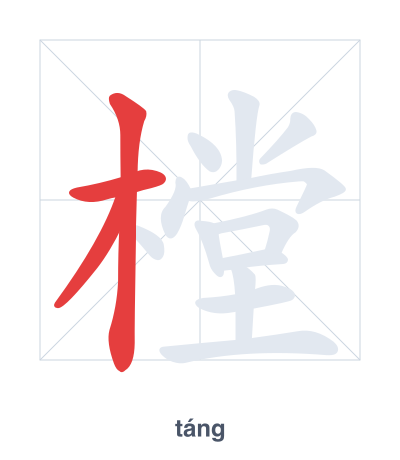
Open Hanzi Writer to see the animated stroke order and practice writing 樘 with real-time feedback.
The character 樘 (táng) is written with 15 strokes. Follow the standard Chinese stroke order: top to bottom, left to right, outside before inside. The radical 木 is one of its key components.
Practice the correct stroke order with the Hanzi Writer app to see animated stroke-by-stroke guidance with real-time feedback.
樘 means Door frame / window frame.
樘 combines the radical 木 (wood) with 堂 (hall, also serving as a phonetic hint táng). The wooden door or window frame is thus literally a 'wooden hall structure' that holds the opening.
💡 Memory Tip: Picture a massive wooden door frame (木) so grand it frames an entire hall (堂) entrance.
门樘需要修理。
mén táng xū yào xiū lǐ
The door frame needs to be repaired.
窗樘是白色的。
chuāng táng shì bái sè de
The window frame is white.
樘柱支撑着屋顶。
táng zhù zhī chēng zhe wū dǐng
The pillars support the roof.
Open Hanzi Writer to see the animated stroke order and practice writing 樘 with real-time feedback.
✨ Animated stroke order · Handwriting recognition · HSK-graded practice · Free to use
樘 is made of the radical 木 (wood) on the left and 堂 (hall/room) on the right. Together, they suggest a wooden part that defines a room's opening — specifically a door frame or window frame.